12 October 2022

Melancholy, The Anatomy of


We love the world too much; God too little; our neighbor not at all, or for our own ends.

I didn't mean to read The Anatomy of Melancholy all the way through at once. I was going to dip in and out of topics and just kind of meander through some pages like a dictionary or encyclopedia. But I accidently read the whole thing. It was that enjoyable I started and just kept reading. 

Every morning with my coffee and journal, I would read just a couple pages. I would follow the tangents that Robert Burton would go on, which would last for pages, and sometimes the next day I would continue on that same tangent. I try to put my finger on what this book is to describe it: is it a dictionary? A journal? A research project on love, morals, and ethics? Inspirational and motivational reminders of Biblical truths? A book of quotes and poetry from ancient wisdom? Tales of woe from those who stray? Thoughts and musings from the author on various topics of health, food, exercise, reading, studying, and magic? A big book of lists?

Well, it's all of the above. Mashed into one giant book weighing in at about 1,080 pages. It's a mammoth collection of Robert Burton's thoughts and quotes from ancient sources that I often wondered how he had access to. Was he making some of this up? Latin quotes fill some of the paragraphs, which thankfully he almost always translates. 

In avoiding errors, fools rush to the opposite extremes.

Whether he was making some of this stuff up, it doesn't really matter. In one tale he tells he actually states at the end that it doesn't matter whether the story is true, it plays the role to tell a truth he wanted to tell. I laughed often whilst reading passages, sometimes because of archaic language not used anymore, sometimes situations are just humorous. It was not only entertaining and informative, it was interesting to read from the perspective of his time in Oxford (he lived there all his life). Published in 1621 (400 years ago!), there are bits of history and politics mixed into his perspective. And indeed, his religious life is the undertone of the whole book.

The chief thing we respect is our commodity: and what we do, is for fear of worldly punishment, for vainglory, praise of men, fashion, and such by-respects, not for God's sake. We neither know God aright, nor seek, love, or worship him as we should. And for these defects, we involve ourselves into a multitude of errors, we swerve from this true love and worship of God: which is a cause unto us of unspeakable miseries; running into both extremes, we become fools, madmen, without sense, as now in the next place I will show you.

I think Robert Burton would have been a hoot to hang out with and talk to. Historic notes from people he associated with noted how friendly and pleasant he was to be around. While he says he wrote this book to keep himself out of despair and melancholy, he states very simply that the solution for melancholy is "be not solitary, by not idle". Writing this book was his way of fulfilling those pieces of advice. I imagine he walked around Oxford conversing with all kinds of people gathering stories and ideas for entering into his book later, because he kept adding to this book once it was published.

He who blends the useful with the charming wins every vote.

He offers sections that are symptoms of melancholy, showing us that we all have the tendency to fall into such a state. He has subsections and tangents. Then, he has a cures section that attempts to encourage ways to resolve the issue at hand - 

For if thou dost not ply thy book,
By candlelight to study bent,
Employ'd about some honest thing,
Envy or Love shall thee torment.
In other words, stay busy, keep focused, work on something that is worth paying attention to. This is a cure for love melancholy, which comprises a whole section in the book. The spiritual battle that we all deal with on different levels. 
Following Plato, calls these two loves, two Devils, or good and bad Angels according to us, which are still hovering about our souls. The one rears to heaven, the other depresseth us to hell; the one good, which stirs us up to the contemplation of that divine beauty, for whose sake we perform Justice, and all godly offices, study Philosophy, &c., the other base, and through bad, yet to be respected; for indeed both are good in their own natures...

It was a pleasure to accidentally read the whole of The Anatomy of Melancholy. I will revisit this book very often. I underlined so many passages and made notes everywhere.  It is most certainly a top favourite book of mine, and sits at a ready stance on my shelf; easy to grab and linger over. 

04 October 2022

Komdu blessaður


Komdu blessaður

Come, and be blessed.

When I travel, I have the profound feeling of being blessed. Visiting churches in foreign countries helps to bring that to the forefront on my mind. I love to go into a church and experience the quiet, beauty, and calm of the place, and take a few moments if possible. All the elements of travel have their uncertainty, and I experience and reflect in a mode of deep thanksgiving that I get to see some places of the world that God has so creatively set in motion. To me, it is truly a gift to get to travel (and I say "get to" because I feel it's such a special thing).

When I get to travel, I feel immensely blessed because I know it's not the norm, especially to places I love to go to, like Iceland and the UK. These are not cheap, quick flights and journeys. Because travel is important to me, I save up my money for a long time, and then take one amazing trip. 

For me, these big trips to my favourite places provide years of inspiration and reflection after the trip. I still reflect on my first trips to the UK (2009, 2010), those first sights of Oxford, the days all to myself exploring Newcastle, England, the epic road trip around Scotland with my brother, and if I go back these kinds of memories go back even farther to my childhood/teens. Travel became a priority for my parents to let us four children experience the U.S. as we never had before. This, I think, installed in me a love for exploring places from an early age that are full of stories, histories, and much different landscapes than I am used to. It awakened in me a resource of inspiration and way to write about things I never would have thought of before.

Reflecting on this kind of lifelong thankfulness as we pass the 13 year mark of losing Dad, I think about how he loved to explore and learn the history of places. He never pushed that on any of us (we were usually impatient for the next thing), but he was the one in every museum and at every historical site reading every plaque and looking slowly at every artifact or monument. He didn't care about the touristy things or the busy-ness of cities. He was there to experience the place and learn about it. He was a great example of what we now might call a "slow traveler". This is how I have adapted my way of travel as I grew up to adulthood, very much modelled after Dad's way of travel. He paid attention to the history and meaning of a place, as I seek to do. 

My family would travel mostly in the Winter (usually around Christmas time when all us kids were on holiday break and Dad could leave because the lawns he mowed weren't growing). So, I have this deep sense of love for all things Winter. That's when I got to travel growing up. That's when I would get to see the amazing Western U.S. played in snow, skied, hiked mountains, gazed at towering waterfalls, and explored the Northeast. I am so deeply thankful to my parents for saving up and taking us four children on such adventures, as I still reflect on those many trips.

The simple act of reflecting in thankfulness can make us feel the blessing that has been present all along life's journey. Sometimes we see the darkness growing, we feel the suffering that comes with being human, and we get lost in a feeling of despair. If you get caught in the spiral of despair, turn your inward eyes toward God, and focus on what you are thankful for now and in the past, knowing it came from Him and He doesn't change. He still wants to bless you. Let the blessing of your past remind you of the blessing that is still present within you now and lighting the way for your future.

21 September 2022

Middle-earth in Iceland


Farewell we call to hearth and hall!
Though wind may blow and rain may fall,
We must away ere break of day
Far over wood and mountain tall.

To Rivendell, where Elves yet dwell
In glades beneath the misty fell,
Through moor and waste we ride in haste,
And wither then we cannot tell.

With foes ahead, behind us dread,
Beneath the sky shall be our bed,
Until at last our toil be passed,
Our journey done, our errand sped.

We must away! We must away!
We ride before the break of day!

- From The Fellowship of the Ring, J.R.R. Tolkien

There are certain places that capture a sense of something else. Something told before. Some bigger story. Occasionally I find myself caught in a scene from such a big story. Usually this happens when I travel and my eyes are open to the different tune of landscape and place. My imagination is an open book, and stories fall into the pages.

J.R.R. Tolkien and C.S. Lewis were extremely fond of the old Sagas from Iceland, Norway, and Finland. They both were part of a society that would meet in their early days of Oxford called the Kolbitars. Or "coal biters", which comes from the Icelandic notion of telling stories/sagas around the fire and sitting so close (because it's so cold) to the fire they could literally nibble on the coals. In this group during their early years of teaching at Oxford, Tolkien and Lewis became close friends, in their shared loved of Icelandic and Norse Sagas. If you read any of Tolkien's writings from Middle-earth you will find bits of such Sagas steeped in, along with images of the landscapes and ancient feeling of the places and the legends. Everything feels old, and part of something bigger than the moment being described.

It's no wonder that when I am in Iceland, I see glimpses of Middle-earth almost everywhere. I hear the words of the books in my head in certain places - the Fellowship travelling on the Great River seeing the grand old statues of the kings of Númenor; the visits into Lothlorien - a wooded realm of the Elves with trees and ancient woods adorned with round staircases and glowing lamps; the grand stone buildings and kingly places of Rivendell, Gondor, and Númenor clothed in white. All the atmospheric locations along the way. Paths into the mountains, leading around kingdoms, venturing into the mist and fog. 
As Frodo was borne towards them the great pillars rose like towers to meet him. Giants they seemed to him, vast grey figures silent but threatening. Then he saw that they were indeed shaped and fashioned: the craft and power of old had wrought upon them, and still they preserved through the suns and rains of forgotten years the mighty likenesses in which they had been hewn. Upon great pedestals founded in the deep waters stood two great kings of stone: still with blurred eyes and crannied brows they frowned upon the North. The left hand of each was raised palm outwards in gesture of warning; in each right hand there was an axe; upon each head there was a crumbling helm and crown. Great power and majesty they still wore, the silent wardens of a long-vanished kingdom.
- From The Fellowship of the Ring, J.R.R. Tolkien
In these places I pause and look around me, feeling as if I have fallen into the story and suddenly something is going to happen as we enter the next chapter. I memorize the space with my eyes, ears, and feeling. I hear the story in my head. I take a deep breath realizing and appreciating that I am in such a place. 

I could go on and on with examples of this in Iceland (and other places I travel to and have written about). Perhaps if you are more curious to read Tolkien you might catch some more glimpses of this sense of the long-vanished kingdom. My journey to Iceland has refreshed my desire to re-read The Lord of the Rings. It might have to happen soon.

14 September 2022

Adventures to Snæfellsnes Peninsula, Iceland


Snæfellsnes Peninsula, Iceland

The drive to the northwest of Iceland was an adventure so much like travelling to another planet. We took a small group tour which picked us up at 9 am. From there, we were no longer in the familiar world.

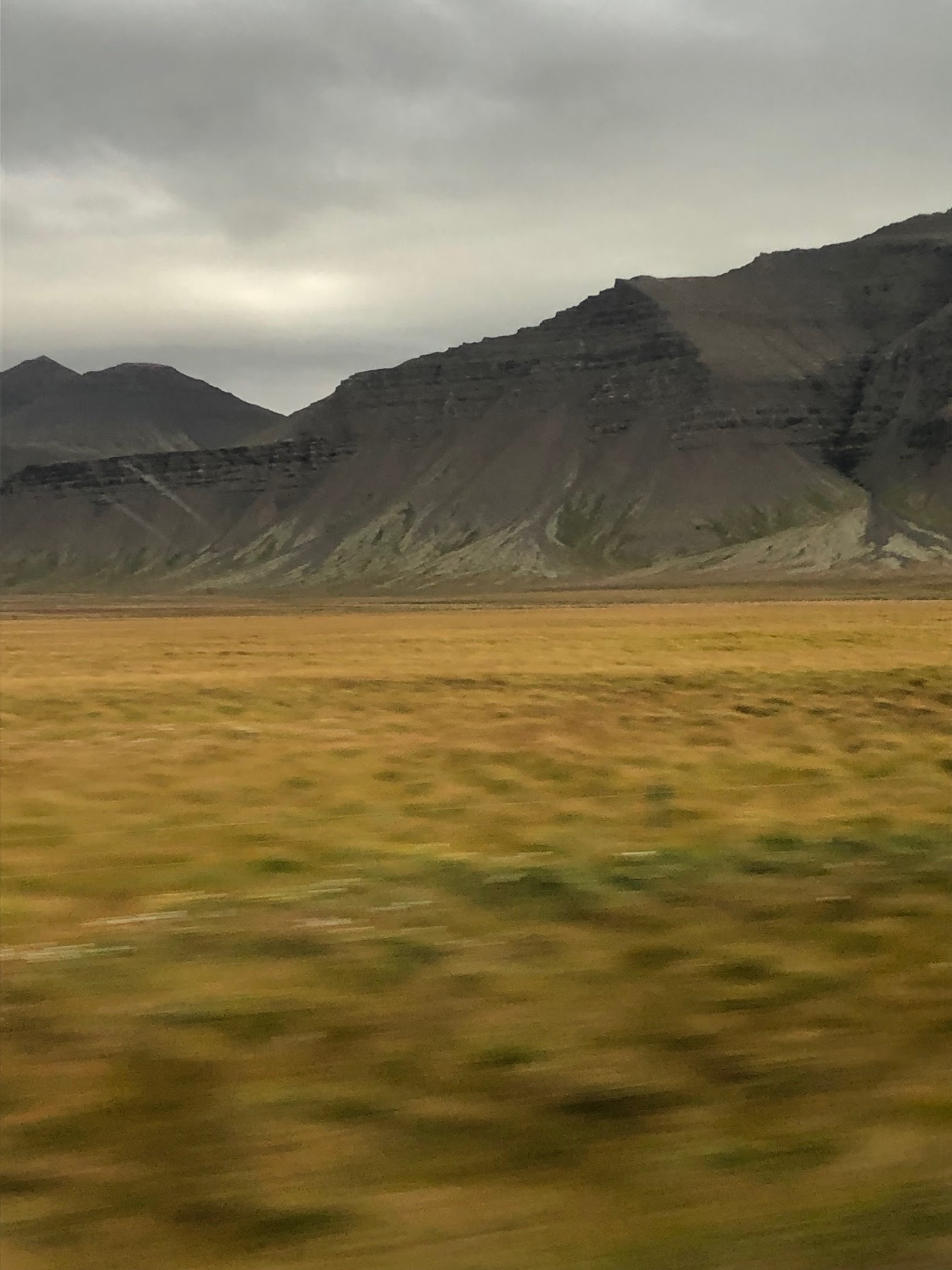
Travel by way of fjords northwest. A long tunnel dips below the water of a fjord to emerge on the other side - the area of the Snæfellsnes peninsula felt like prehistoric Iceland: whale bones on the beach, chunky grey-blue rocks, and tiptoe grass layering above the sands, all set against the backdrop of the darkest mountains I have seen. Black and imposing, even in the midst of layers of cloud and fog. My imagination sparks alive in this atmosphere. Pausing for the most delicious home cooked lunch at a horse farm, with breathtaking views out the window of said dark mountains. It was here the rain started but there were more dramatic locations to experience. For in Iceland the saying goes that there is no bad weather, just wrong clothing.

The moody, misty atmosphere accompanied the rain and with a bend in the road the sea and dramatic coast came into view. One can not neglect to stand in awe of such scenery, even amidst raindrops.

The famous black church standing firm on the unprotected hillside, exposed to the winds coming off the crashing sea. Huge, mossy boulders broke away from the coast now seem to be frozen in a poetic stance. Protector of the region, statue of Bárður Snæfellsás watches over the paths along the cliff side, ready to help a lost or troubled hiker. I just read/listened to his saga before leaving for Iceland, so it was particularly enjoyable to see the place connected with the saga literature. And the dramatic cliffs rise high above the tumultuous sea. One can just stand there windswept and wet, not wanting to leave that spot too soon.

The atmosphere was mystical and otherworldly and as my nose was glued to the window I could easily see the stories of old running across the lava fields, dancing along these crevices. I could feel the words forming into story - if I had my book out to write I could have started my next tale, but I couldn't take my eyes off the landscape. Still rainy, we drove along the thin roads to the black sand beach Djúpalónssandur, which is like a scene from a mystical epic. Strange rock formations and lush green moss growing on them leads down the path to the black sands. Scattered remnants of a shipwreck from 1948 dotted the wide beach down to the rough waves. It was very mysterious standing there amidst waves and wind, sweeping the past into present.

Icelandic Fog

Foul and dull you dismiss

the fog of our fatherland -

don’t you realize it is

the creator changing his mind?

Like you, he wants the weather

to bear a fitting name,

yet he demurs at either

the sunshine or the rain.

(Stephan Stephansson)

07 September 2022

Coffee in Reykjavik


Coffee in Reykjavik

The fire and ice sit atop water
smooth like glass on days of grey.
Ragged and wild every other day.
Travelling over mountain and volcano
winds flow across the land and sea
to breeze up the Kárastígur to me.

I order cappuccino and say takk.
A staple order for a coffee stop.
I gently clang my cup back into saucer,
and write more pages to an empty cup.

It's calm for a moment, the steamer heats
the milk for cappuccino to guests
who glide in with loud voices
American sound rises above the rest.

I take the quiet route and slide back
in my notebook, jotting words in mind.
Observing and enjoying the coffee vibe
and hurried figures passing to find.

(At Reykjavik Roasters on Kárastígur)

05 September 2022

Nordic Summer in Reykjavik


Reykjavik, Iceland
End of August 2022

The sky is still light at 10 pm (last photo). Sunsets are something so dramatic and beautiful, changing every minute, we watched the sky as an evening show from our room each night.

It's still Summer in Iceland, in fact, they only have two seasons - Winter and Summer. Summer, with temperatures from 45-58 degrees Fahrenheit, is like the Winter I know in my Florida life. This air is refreshing. The windswept landscapes seems otherworldly, but I will get to that soon. For now, we are in Reykjavik, the capital city, population just over 200,000.

 We arrive in Iceland at 6 am, after an overnight flight through NYC - JFK airport. A long day of travel and overnight (with no sleep) is always a challenge, but when time is limited, you seize every moment you can and hit the ground running. Or, at least, keep going all day and then crash early that first night.

Mum and I were eager to get out into the city to re-familiarize ourselves with Reykjavik. Our last visit was March 2018 and I think we have been dreaming about it since. We ended up walking around all morning, afternoon, and then crashed at 7:30 pm into our beds. The sun was still up. 

First, coffee. Actually, first, breakfast at our hotel. Then, off to the favourite coffee shop (with several locations around the city, Reykjavik Roasters. Good quality coffee is something I keep coming back to.

We stopped into the lovely Hallgrimskirkja Church where the organist was putting on some practice/composing that drew quite a crowd. We sat to listen for a bit. We took the elevator to the top for the amazing 360 degree views of the city. One of my favourite things in a city is to get up above it to gaze out and get the scope of the layout. I love studying maps and this is kind of like a live version of a map looking down on it all.

Lunchtime called us over to a new location of Reykjavik Roasters (part of an art gallery) where we got a quinoa bowl before touring the museum around the corner of Iceland's first sculptor, The Einar Jónsson Museum. This was a very interesting museum me to me, and it only made me want to research the pieces more, as they were all symbolic and full of imagery. A lot of the pieces reminded me very much of William Blake's artwork.

We walked down to the waterfront for the views of the city and mountains across the water. We stopped in a bookshop to browse. Yes, it was a busy day and we didn't stop. After some dinner at an Italian spot on the way back to the hotel, we crashed, because the next day would be a fun adventure around the city. I was filled with thanks to be there.

17 August 2022

The Super-Infinite Donne


...in these new heavens and new earth, for ever and ever and ever, and infinite and super-infinite forevers.
- John Donne (from a funeral sermon)

The thing about historical figures is that they (over time and to our culture as it shifts focus) tend to be known for one or two things, which becomes so engrained in the social views and splashes of information, eventually leading to a sort of stereotype without understanding. Any figure who is shrouded in some cloudy historical data is prone to this kind of treatment where gaps and holes are everywhere.

An example of this would be William Shakespeare. I bet you know a lot about Shakespeare, but do you? Could you tell me much about his life at all? His process? His daily life and associations? Maybe you know that he wrote plays and then had them performed at The Globe Theatre on the river Thames in London? Another figure I have admired for many years without knowing much about in this sense is John Donne.

I have always been a bit mystified by the life of the poet John Donne, only knowing a few snippets of his story. Thanks to this new biography, I know a good bit more. He lived in London during the time of Shakespeare (1572- 1631), yet history is rather fuzzy during this era about many things regarding his family life, his siblings, and simple regular historical records. This is partly due to the great fire of 1666, which tore through the City of London and destroyed libraries, buildings, records and his home. His mother was the great-niece of the martyr Sir Thomas More (who wrote Utopia). Many members of his Catholic family were killed for their faith, including his brother who was hiding a priest in his lodgings during a time of persecution.

Such ponderings might arise, for example - did Donne and Shakespeare ever meet, and if so did they talk about poetry and the imagination? They lived at the same time and attended some of the same events. Shakespeare's plays were going on across the river Thames from where Donne lived (did Donne go to any plays? Surely he did). They lived through times of several deadly plagues and immense suffering, as well as the ongoing religious strife between Catholics and Protestants. Donne ends up converting from his Catholic background becoming a clergyman and then the Dean of St. Paul’s Cathedral. He became one of the beloved and well respected figures of London as the Dean, giving many sermons that drew huge crowds.

The ends crown our works, but thou crown'st our ends,
For, at our end begins our endless rest,
This first last end, now zealously possessed,

I think I could ponder on these lines, alone, for days, and his use of the word "end" five times in three lines in relation to a crown and the infinite round circle that a crown exemplifies.

He wrote some of the most multilayered, beguiling poetry in the English language, 200 poems in fact. He was first known for his love poetry, with double meanings and sensual themes. He played with language, creating many words that have their first source of usage in the Oxford English Dictionary from Donne (the word 'commonplacer' for example). Over time as he moved into the role of a clergyman his poems retained all those multi-facets and double-meanings but directed toward the spiritual life in layers and layers of meanings hidden in the poems. I love how the author says Donne was a man so in control of his poems he could layer them with a dozen references. He could write a twelve line sonnet that will take you a week to read. I wrote in the margin next to those sentences "so true". That's definitely how I feel about his sonnets.

Thanks to this new book by Rundell, I now better connect the poems to his life with a fresh understanding and appreciation. Here is a favourite divine poem of mine, that C.S. Lewis borrows the first line for one of his essays:

What if this present were the world's last night?
Mark in my heart, O soul, where thou dost dwell,
The picture of Christ crucified, and tell
Whether that countenance can thee affright,
Tears in his eyes quench the amazing light,
Blood fills his frowns, which from his pierced head fell,
And can that tongue adjudge thee unto hell,
Which prayed forgiveness for his foes' fierce spite?
No, no; but as in my idolatry
I said to all my profane mistresses,
Beauty, of pity, foulness only is
A sign of rigour, so I say to thee,
To wicked spirits are horrid shapes assigned,
This beauteous form assures a piteous mind.

08 August 2022

Selador: Forbidden Realms - Go Buy Your Copy!


Selador: Forbidden Realms is out now! 

I've been awaiting this day with heightened anticipation - the release of my new book!

Go buy your copy on Amazon

This is Book III of my Selador series (all are available on Amazon):
1. Selador: The Book of Time
2. Selador: The Secret Paths
3. Selador: Forbidden Realms


Preview section (from Chapter 7):

Sankin looked like he was going to speak, but Soren shook his head and urged him forward. 

Sankin finally did speak as they walked beyond the gate, “What is this place?” 

Soren was already musing the same question, “A city deep underground. A once wealthy and magnificent place.” 

“Why is it not still?” 

“Did we pass a soul on our way here? A city like this with several gates and checkpoints would have been very grand, and a lot of traffic would have come through here I imagine. It seems rather quieter than it once was.” 

“So this is a perfect example of my vision come to life in a larger form,” His smile was growing, “A great underground realm with so much potential – this could be inspiring.” 

Soren ignored him because he was considering the link with Selador. He proposed in his mind that when this city was bustling, the portalis was being regularly used from Selador, linking the two realms where travellers could come and go using the underground paths that would have linked several locations. 

Since that practice stopped in the Second Age, this city of Arunedil felt the direct impact of not having that link from Selador and perhaps other places. He was eager to see the city that, to him, would be a treasure of history. From what he noted of the guard’s uniform and the intricate carving of the gate, it was once a city of immense beauty and wealth. Was it still?


Will you read the whole series? 
Have you read the other two books?
I always love to hear from readers on thoughts they have on the story, so please reach out to start a conversation!
Thank you to all the support and love for my stories. It means so much.

03 August 2022

July Reads


I haven't posted a quick reading update in a long while, so I thought I would share a few of the July reads I have been digging into and learning from. What did you read in July?

Emma by Jane Austen
I haven't read a Jane Austen novel in a long time (too long) and I would say the perfect summer time Austen book is Emma, which has been so fun to re-read. I am picking up so many of the nuances (irony and satire bits) that I absolutely missed in my previously readings years and years ago. The new film adaptation is pretty good (definitely entertaining and vibrant) but I will always say the book is better and I stand by that claim. Austen captures the social aspects and the personalities of the characters so well in the dialogues. You can tell when Ms. Bates talks on and on for a page and a half, jumping from one topic to another like a distracted squirrel, that being around her for more than a short time would be exhausting. You can read how well Emma's attitude and stance on social situations (and her matchmaking) feeds how she thinks she is correct in everything, when she is actually completely and utterly wrong, wrecking havoc over many lives. She is blind to many things, which creates the mishaps (like a comedy of errors) that occur throughout the novel. I got my mum to read this with me, and I hope she's enjoying it.

Aristotle's Way by Edith Hall
This summer I have been fully diving into philosophy. I wrote about this before, and how I missed through my schooling having any sort of adequate dive into philosophy. I am catching up now, reading and listening to lectures and talks on various thinkers through the ages. Aristotle is pretty much essential reading as an ancient philosopher who still resounds today. I read Aristotle's Poetics earlier this year and loved it, so this was a great follow-up to that, with even more information on how he lived and thought. So much of our modern view of how to live a happy life (a good life) comes from Aristotle. 

Till We Have Faces by C.S. Lewis
I have been wanting to re-read this wonderful book for a couple years now. My deeper dives into philosophy and early Greek teachings have really motivated me to pick this up again, and I am so glad I did. This book is nothing like other Lewis books, but it's right up his street if you know anything about Lewis's interests and study of myths. It's a story from the perspective of the ugly sister, Orual, to the beautiful Psyche, taking place in pre-Christian times. Their father, the king, is a bit unhinged, and he follows the priest's (to the gods) advice to sacrifice his daughter, Psyche. She is left in the wild for the beast to claim, thereby freeing the king. Psyche is, instead, claimed by the god, Cupid, who loves her and she lives in joy with him. Then, Orual travels to visit and see her sister, overjoyed to find her alive, but her jealousy changes everything.

Bullies and Saints by John Dickson
I am deeply interested in learning more about church history, leaders, and events in what has shaped the church since its establishment in the first century. Sometimes we only know the tales as they are told from one side, glossing over the background motivations behind some particular event. The church is not innocent through history - some of the decisions made by leaders of the church caused death and destruction (think about The Crusades, which is just one example). There are two sides to the actions. Good and bad have been done. I am soaking in the knowledge so I can feel my way around history and understand how sweeping changes were caused. I believe the only way to understand what might be happening in our nations and churches today is to look back and grasp some of what already happened (leading to ramifications we feel today).