22 June 2022

How We Think


Genius, like a thunderstorm, comes up against the wind.
- 
Søren Kierkegaard, The Journals

Your knowledge about something might be false, and not actually knowledge. You might think it to be true and you hold onto it as it it were total truth, but you might not be correct. Have you considered that? Where are you getting your information to form that knowledge and belief? Does it come from the news, movies, tv, social media, chit chat? What about books? Previous thinkers? Scripture?

I've been edging (dangling, really) along the rim of the deep end of philosophy for years. Interestingly, I have never taken a philosophy class (except one time, back in January 2013, when I was staying with a German friend who was studying at Yale, we snuck into a philosophy class staying the whole class and I was completely fascinated. The professor asked who we were at the end of class, and the story was that I was a prospective student and she was a current student interested in philosophy. This was the epitome of nerdy thrill for me. Defying the rules in the name of learning to be in a class at Yale). In the study of philosophy, the questions asked begin with defining knowledge. How do we know something is true? There is a difference to something being true and our knowing something to be true. The questions of knowledge change the way I think about it. 

It makes me think about how we all think. Where does the "truth" come from for most people? Is it something just accepted without second thought? I hesitate to say we need to think for ourselves because I don't want it to seem like it should be a selfish thing, for the idea of "ourselves" looks inward, but rather we should hold an independent thinking that looks at all the questions and tries to research and figure out what is the best answer that lines up with following God. Like sheep, we humans have the tendency to follow the crowd, lead by big leaders or powerful voices, without thinking, just following and mimicking. 

Something in me has always resisted this tendency to just follow without thinking. From a young age, I felt this, and usually went the other way from the crowd, which meant the reality was I was often left out and didn't quite fit in during those tough years of middle and high school. I felt okay with it, though. I don't remember it upsetting me too much, because I knew there was something better to explore in thinking independently with my own thoughts. 

So it makes sense that these tastes of philosophical thinking appealed to me as I stumbled into them through various books and ideas, most likely finding their beginning with Søren Kierkegaard. In high school and college I frequented the Selby Public Library in Sarasota, which is a grand white, beautiful library downtown, and they have a "friends of the library" bookshop, which is where I have picked up a wonderful array of books over the years. I am pretty sure this is where I picked up my copy of A Kierkegaard Anthology (a lovely Modern Library clothbound hardback in a dark burgundy shade) not knowing where this introduction and $1 would take me. 

I thumbed these pages, dipping into the Danish Christian philosopher's various selections of texts that this anthology contains. I did not understand much of it, but I would read and re-read the parts that were reaching into a depth I could just barely put my toes into, and then I would set it aside, and come back to it, again and again over the years. Each time grasping a tiny bit of what his genius mind was pondering. I have re-visited this book so many times over the years, I've lost count. 

In those early years I underlined lines that made me ponder as I never had before (a few examples):

- The stone which was rolled before Christ's tomb might appropriately be called the philosopher's stone because its removal gave not only the pharisees but, now for 1800 years, the philosophers so much to think about. (The Journals)

- ...that God has absolutely nothing obvious about Him, that God is so far from being obvious, that He is invisible. It cannot immediately occur to anyone that He exists, although His invisibility is again his omnipresence. (Postscript)

- We are all so much more apt to think about discovering evil than about discovering good. (Works of Love)

Since then, I have collected and read several more of his full books, studying his life and ways of thinking, and have a better understanding of who he was and what he believed. He was my first dip into philosophy, and I think will be a forever favourite. However, I have much more to learn and read on a wider scale. It is, after all, a life long learning experience we get to indulge in - searching for answers to the mysteries of life.

The analogy between faith and the ethical is found in the infinite interest, which suffices to distinguish the believer absolutely from an aesthetician or a thinker. But the believer differs from the ethicist in being infinitely interested in the reality of another (in the fact, for example, that God has existed in time). (Postscript)

15 June 2022

Tolkien and Tea


I am making jasmine green tea again. I say "again" because I am hooked. It brings back fond memories from early adulthood, jasmine green tea does. For some reason I used to drink it all the time. I cannot pinpoint a reason why I got so hooked on the slightly floral delicately scented green tea, but I did. This was even before I first went to England. Thanks to my recent trip to St. Augustine, I am hooked again. I rekindled our friendship at a coffee shop called The Kookaburra, where I tried their jasmine green tea with oat milk and coconut. It was delicious. And it made me remember how much I used to drink jasmine green tea. Well, now I am making little pots of it left and right, adding a little oat milk this time, and sitting down with Tolkien.

It is a rare treat now to have any new release from Tolkien, yet somehow he still continues to produce books. After passing away in 1973, his son Christopher was left with editing and releasing all his Middle-earth writings and has done an amazing job with organizing and putting together his father's papers from his legendarium, which was not in any organized state. With Christopher's passing in 2020, the Tolkien estate is leaving the hands of his son to another set of capable hands, who Christopher trusted and had been sending documents to all along. Carl Hostetter had been receiving notes and papers from Christopher since 1997, and this book is the result. It's a collection of the nature of Middle-earth, by which he means the physical world, land, flora, fauna, and also the metaphysical qualities of the world and those who lived in it. 

Did you know Tolkien was kind of a numbers nerd? He seemed to enjoy putting numbers to his works. He calculated the age differences and year differences between the elves and men. He built vast histories with numbers. He ran into chronology issues in the stories and had to adjust his timing when things took place from the beginning of creation. He created these elaborate charts calculating the offspring of the elves from their awakening. There are pages and pages of his calculations of each generation of elves: how many were born, how many were in the population, etc. He was basically creating excel spreadsheets by hand, back in 1959. While the calculations are fairly simple, it's still impressive, because it's so expansive and detailed. Those are words that would describe Tolkien rather well, I think: expansive and detailed.

The thing I love about new Tolkien books that are released is how I get to learn more about him that I never knew. Such as the youth and lifespan of elves. I chuckled in one section where Tolkien wrote about how the elves consume mushrooms, then noted at the end it says that in the margin a rough pencil note by Tolkien says "Delete all this about funguses, too like Hobbits." I get to read his scribbles that have never been seen in publication before. It's a glimpse into the past, and into his mind, how he worked, how he built the history of Middle-earth, and I am continuously amazed again and again.

09 June 2022

Sun Rise to Summer


St. Augustine Beach

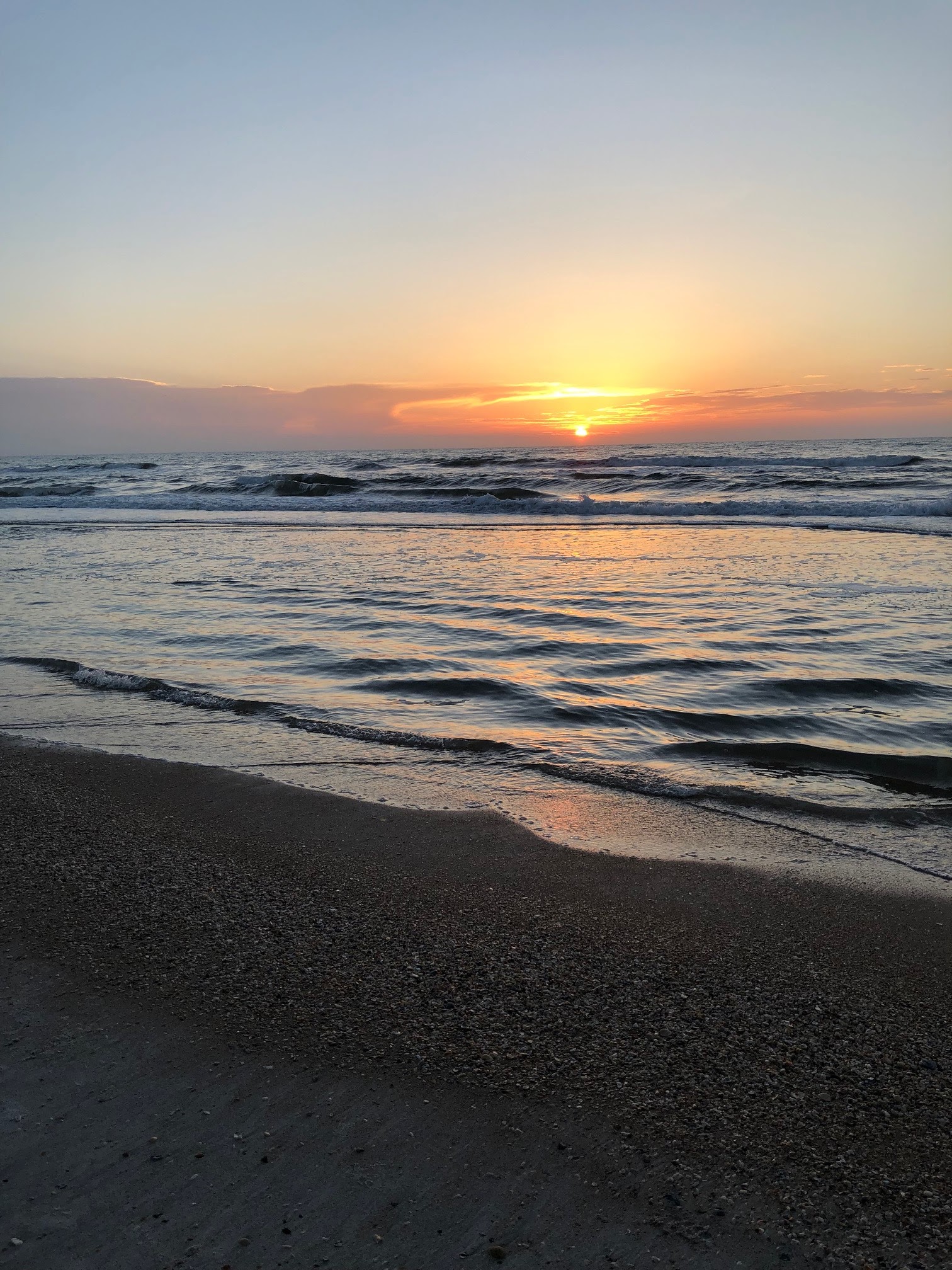
The sun rises on our long summer months. The heat has now nestled cosily into the landscape and there is no escape, even at 6 am as the sun begins to glow at the horizon. But that is the time I want to go to the beach. The sound of the waves permeates the atmosphere when it's still dark. The walk toward the beach is quiet except for a cheerful bird along the boardwalk and the waves. A handful of people are scattered along the beach. The coming dawn is peaceful as it takes a deep breath before opening to a new day. Nature is the focus. God's creation and beauty takes center stage. The light changes every half-minute and my eyes have a hundred places to look every moment. 

I was just in St. Augustine for a couple day getaway with the family. To be at the beach is to experience the fullness of summer. The heat and humidity. The sand-strewn streets. Surfboards and bikes. Bright colours and wooden cottages. For those who love the heat and sunshine, this is their time. 

Walking to the beach at 6 am the planets were pausing over the ocean, looking east. Venus, Mars, and Jupiter saying good morning before the sunlight emerged. A layer of thin, low clouds were at the horizon where our star emerged slowly. To me, clouds added beauty as the colours changed and the light altered from their influence. I stood at the water's edge hearing and watching. Attentive to the beauty of early morning. It's such a delicate time of day; my favourite time of everyday. A restoring and reflective span of the hours we are awake (if we wake that early). A reminder that all things dawn in God's hands. All shall be well, and all manner of things shall be well.

07 June 2022

St. Augustine - City of History


I love history, even more now than in my younger years. Maybe that is something we appreciate more as we get older. Understanding where ideas and cultures come from interests me, and the landscapes in which these things develop. Wherever I go in my travels I want to learn and experience the historical significance of a place and appreciate its unique story. St. Augustine is known as the oldest city in the nation, so there is much to learn here.

With very limited time, I did not get to do too much in the way of learning a lot of St. Augustine's history, but I was able to collect a few snippets. I would love to go back in the winter time when it's pleasant and cool to walk around outside, rather than the 90+ degree heat, high humidity, and intense sun. The city was established in 1565 by Don Pedro Menéndez de Avilés. He sailed from the port of Cádiz, Spain. The day he first spotted the land of Florida was the feast day of Saint Augustine of Hippo, therefore he decided to name the first settlement after Saint Augustine. 

A quick stop at the Cathedral Basilica of St. Augustine was a must. Obviously, the connection to Saint Augustine is clear here. It was built in the Spanish Mission style and dates back to the 1700s. The cathedral holds a piece of Saint Augustine's finger bone as a relic. A stature of his mother, Saint Monica, is at the back of the cathedral. If you read The Confessions of Saint Augustine you will be familiar with his story and the role of his mother. The stained glass also has depictions from The Confessions.

Visiting the Lightner Museum was a delightful mix of interesting history and architecture (it was originally built as The Alcazar Hotel in 1888 as a luxury resort complete with a bottom floor that was a pool and different baths and spas were on the upper level along with a casino and ballroom) as well as collections of interests and art. The building itself is worth a visit, built in the Spanish Renaissance Revival style, you can tour through the rooms where baths once were and see the pool area that is now a small café, surrounded by the mezzanine level collections of art and furniture. The collection of marble sculptures, paintings, furniture, glass, etc is very enjoyable. It was not crowded, so it was a relaxing wander through all the levels of the old hotel on a very hot day.

25 May 2022

Magical Shelves


There was once a young girl who had a few shelves of books allocated to her on the big family set of bookshelves. She would take a gander at them often, pulling off a favourite to re-read and put back one just finished. They were just everyday shelves of books, and yet they were full of magic. Those shelves were very well known by this young girl, because her eyes would wander over them all on a regular basis. She knew the locations of all the books, even her brothers' collections, and what books were included. She knew the encyclopedias as deeply as her own dedicated shelves, for those chunky, large books would often come off the bottom shelf, and right in front of the shelf the young girl would sit cross-legged on the floor with the selected book open on her lap. There was no internet, at least, not for several years, and even when there was dial-up it was not used very much. This was exploring the world and the abundance of knowledge, but through the lens of books.

She would eagerly anticipate every trip to Walmart (the old school stores of the 1990s) because there was a small book aisle, where she could peruse the 4-5 shelves of paperbacks and inevitably end up with one to take home. It felt like carrying a treasure around the rest of the shopping trip with a new book in hand. Those shelves were also full of magic.

That girl grew up but she stills feels the same thrill of a new book and a familiar book pulled off a magical shelf. I do not shop at Walmart, but whatever bookshop I might be in (or when one arrives that I ordered - book mail is my very favourite kind of mail), holding that new book awakens that childhood sensation of wonder and mystery at what lies behind the cover in black ink on hundreds of pages. That eagerness to stop everything and read it the rest of the day is the same strong urge every time. Of course, now as an adult I more often have to set it aside to wait patiently for time to read, but it sometimes could be right then and there I open that cover.

I am still that girl who wanders her shelves, pulling off titles to re-visit or just dip into. The joy of revisiting a loved book is in the deeper discovery (or even new discovery) of something missed before or perhaps forgotten until eyes settle on those words again. Reading a good book again will open the approach to fresh perspective. The book hasn't changed in those years, but I have. And my attention might be catching different aspects I never saw before, with reflections on my life, which probably has something different going on than when I first read it. This is also why reading Scripture again and again is so beneficial. There are always varying insights to gather from good books. We have much to learn at every turn of our lives. And good books are that steadfast place to return to for wisdom, insight, and perspective. 

18 May 2022

Interlude for Anatomy of Melancholy


...thou shalt soon perceive that all the world is mad, that it is melancholy...

I offer this appreciation interlude for the labyrinthine masterpiece that is The Anatomy of Melancholy by Robert Burton. There may be more interludes to come, for this tome is a rather hefty one at 1,100 pages, so I imagine I will be dipping into this one for quite some time, and can see that this is the kind of book I will revisit again and again. Robert Burton lived in Oxford and wrote this for himself (as the subject), he writes, to aid himself in his own melancholy, showing us that his own interests and talents were essentially a cure to his own melancholy. To keep busy doing what he loved to do, fulfilling his purpose. He does write as a summation after 1,100 pages of diversions - "Be not solitary, be not idle" and we can all take that into our own souls to ponder the truth in that when feeling melancholy.

Examine the rest in like sort, and you shall find that Kingdoms and Provinces are melancholy, cities and families, all creatures, vegetal, sensible, and rational, that all sorts, sects, ages, conditions, are out of tune...In whom doth not passion, anger, envy, discontent, fear and sorrow reign? Who labours not of this disease?

I love this idea of being out of tune. We can all relate to that as a human condition. Burton shows that all of us are affected by melancholy at some points in our lives. It used to be known as a disease, and I suppose today it would be more so categorized as depression. However, the term melancholy seems more approachable to me, for we can all think about times where we are caught in a mindset of melancholy, no matter how short-lived. This is an everyman's book. Full of humour and anecdotes - surely Burton would be a hoot to hang out with. Records and letters show that he was.

It's difficult to describe what this book is exactly - published in 1621, it is a collection of writings, musings, history, diversions, and poetry exploring various aspects of the human condition (cutting up each of the aspects, or anatomizing them), subdivided into sections of causes of melancholy and then cures for melancholy. It is full of diversions and side notes, stories, quotes, many lists, and tales from Roman and Greek philosophers. He often throws out quotes in Latin in the middle of a sentence (which are translated, thankfully). He was a Christian, and he pulls quotations from Scripture. It has medical aspects that would impact one's melancholic state, as well as looking into one's mental awareness. I think our modern world of mental health and medicine should pay attention to this book. There is a lot here that is not considered today.

How many strange humours are in men? When they are poor and needy, they seek riches, and when they have them, they do not enjoy them, but hide them underground, or else wastefully spend them. O wise Hippocrates, I laugh at such things being done, but much more when no good comes of them, and when they are done to so ill purpose.


I have reached my favourite subsect thus far, titled - 

Love of learning, or overmuch study. With a Digression of the misery of Scholars, and why the Muses are Melancholy.

I can very much relate to the "overmuch study" (and will use that phrasing from here on as it makes me chuckle), even though I am not a technical student at the moment, I consider myself a life-long student, poring myself into study of books and writing my own books at my own peril, so indeed, these words ring very true to me when he gives - 

...many reasons, why students dote more often than others; first is their negligence...only Scholars neglect that Instrument, their brains and spirit (I mean) which they daily use, and by which they range over all the world, which by much study is consumed.

Now, I shall go back to my writing, but hopefully not to neglecting my brains and spirit. 

04 May 2022

That Girl Who Reads Poems


I realize that I might be in danger of being known as that girl who always reads poems for every situation (and that's okay, because poems written by those I deeply admire are words wiser than my own). With every speaking opportunity I am given (through church or other gatherings) and with every written opportunity I am given (articles, cards, etc) I find myself reaching for a poem to read or write.  I apologize in advance if you ask me to lead/speak/write, for you will surely be faced with a poem.

A poem (or fragment of a poem) is going to be short to read (often not even reaching the right margins or bottom of a page) to convey something big I am trying to say or wish to explore in a concise yet beautiful way. 

So this book I stumbled upon a couple weeks ago, Rhyme's Rooms: The Architecture of Poetry by Brad Leithauser, showed up in my life right at the ideal time, casting that reinvigorated enjoyment of playing with words in the ways that poetry can (much more than prose). 

I love the author's opening of the book detailing the way poems set up a certain expectation to the reader, as one who is not aware of where the poet is going, to hopefully present a pleasant surprise by delivering a clarity and beauty that one did not even expect. This is a wonderful gift we have as humans to appreciate "that primal human pleasure, rooted in inadequacy and ignorance, that arises when clarity dawns unexpectedly: the joy of enlightened surprise." He introduces this as the prosodic contract of the poet (it's the pattern and rhythm and sound used in poetry).

Then, the book dives into the various aspects of poetic architecture, and it's such an enjoyable ride through the structures of rhyme schemes, meter, stanzas, patterns, indentation and capitalization, enjambment, iambic pentameter, iambic tetrameter, off rhyme, rim rhyme, etc. Along the way, he includes fun little poetic puns (oh yes, puns are discussed as poetic elements, too, as saying two things at once) and while I do have a natural inclination to enjoy reading a book about poetic structure (and most would not), it was never overdone with technical language. In between good examples pulled from all ages of poetry, he would include fun little lines that made me chuckle, like a good P.G. Wodehouse novel. 

For example, in his chapter on "Enjambment" (the running over of a sentence or phrase from one poetic line to the next without punctuation), he writes:

The word is derived from the French enjamber, "to stride over" or "go beyond", and ultimately from jambe, "leg". You might say that an enjambed line is legging it.

I am a forever advocate for reading more poetry, which is meant to be read aloud, for the ideal appreciation of it's structure, sound, meter, and rhyme. It's impossible to sum up the book in just a few short paragraphs. I might need to write a poem to sum it all up, but in this age of distraction and too much information at our fingertips all the hours of the day, I loved his line - 

Poetry is forgiving of almost any shortcomings we show it, except the disloyalty of inattention.

27 April 2022

Measuring the Seasons by Light


I measure the seasons by the dawn light streaming into my east-facing kitchen each day as the angles of light hits the table in my tiny home. Here in the photo from about a month ago, the light was lined up almost perfectly like stripes on the table. Already though, that has shifted, in the last couple weeks, the light has cut a varied path, grazing the table at a sharper angle from bottom left, to upper right. The season is shifting. 

Spring days were blooming sweet and fine - 
The heavenly wisdom allotted such time - 
To shape hearts of many by love so divine.

It is interesting how subtle shifts in our lives can easily go unnoticed - whether it is a seasonal shift or some other relational shift. We tend to get so trained in our everyday we focus on our schedule or the next thing we need to do, rather than noticing the moment we are in and what might be happening in it. What beautiful mystery might be wrapped up in that moment?

Something I have been working on for years is noticing and appreciating the moment I am in. In our modern distracted world, I have found that it takes a lot of effort to slow down but when I actually do, I realize how deeply my soul needs that. Part of this effort has been made by simplifying my life in myriad ways, from decluttering and organizing, choosing fewer products to buy in general (and not buying cheaply so I don't have to replace the item in one season), and making the simplest moments lovely and special. I might drink coffee or tea in my favourite antique cup and saucer because I want to, and it enhances the experience and causes me to slow down to enjoy it. 

These small things add beautiful moments to my life, but they take a little bit of effort. Is it easier to buy cheaply and throw everything away? Is it faster to make coffee and drink out of a paper cup to toss? Sure. But there is something missing for me (aside from the environmental impact) - the enjoyment aspect. We are meant to enjoy this life we have been given. I want to savor each moment in its own unique way that it is. Each season holds treasures in it that we might gloss over if we move too fast. 

So, measuring the seasons by the light on my kitchen table has been a way of just simply noticing that in the bigger picture, our planet is tilted and as we circle the sun our seasons shift as we get a tiny bit closer or farther away from our star, and that huge solar system movement impacts me here directly in these tiny ways every single morning, by the light shifts. But only if I am willing to notice. This noticing isn't going to change the world, but it just might change my view of it, by appreciating all the wonder-filled moments that are present every day. And that appreciation goes beyond myself and outward to others.

22 April 2022

Week of Books - The Seven Dials Mystery


The Seven Dials Mystery
Agatha Christie


"You'd have liked him, Father. I never saw anyone more cheerfully inefficient than he was."
"I don't like anyone who comes and dies in my house on purpose to annoy me," said Lord Caterham obstinately.
(Page 35)

Sometimes you just need a good murder mystery, as Aristotle would say, because we take pleasure in the image of a murder. Perhaps because it is so distant from our actual everyday experience - twists and turns, dangerous clues, intrigue. And if it's Agatha Christie, it's just a fun read overall.

This murder mystery had me chuckling quite a lot. It reads much like a P.G. Wodehouse novel, which always make me laugh. The set-up is a group of young people, who decide to play a joke on Gerry Wade, who tends to sleep in everyday until almost noon. They decide to buy eight alarm clocks to place in his room and set them all to wake him at 6:30 am. Except, the joke backfires. He doesn't wake up.

This starts the mystery of how he died. Accident? Murder? The more Bundle investigates this question, the more she somehow gets wrapped into a secret society, warning notes, another death, and her own inquisitive nature that puts her in danger.

I love how Agatha as the creator of this story leaves clues and breadcrumbs along the way, and when you get to the end when it is revealed, you look back and see how obvious it was if you had paid attention to those clues.

Maybe I was so distracted along the way, having a grand time with these characters and fun dialogue. 

"I haven't been to London," said Bundle, "I ran over a man."
"What?"
"Only I didn't really. He was shot."
"How could he have been?"
"I don't know how he could have been, but he was."
"But why did you shoot him?"
"I didn't shoot him."
"You shouldn't shoot people," said Lord Caterham in a tone of mild remonstrance. "You shouldn't really. I daresay some of them richly deserve it - but all the same it will lead to trouble."
"I tell you I didn't shoot him."
"Well, who did?"
"Nobody knows," said Bundle.
"Nonsense," said Lord Caterham. "A man can't be shot and run over without anyone having done it."
"He wasn't run over," said Bundle.
"I thought you said he was."
"I said I thought I had."
(Page 52)

21 April 2022

Week of Books - Poetics


Poetics
Aristotle


A common phenomenon is evidence of this: even when things are painful to look upon - corpses for instance, or the shapes of the most revolting animals - we take pleasure in viewing highly realistic images of them.
(Page 20)


I am not sure how I haven't picked this one up yet, but I am so glad I did. An alternative title for it could be "Advice to an Aspiring Author (with special notes to the murder mystery writer)". In this book, Aristotle is rejecting the previous philosophy of Plato's in the theory of ideas, and branching out to his focus on philosophy, poetry, and history. He sketches out the development of poetry, and argues how it is more philosophical than history, where history just give facts and poetry explores universal truths. The depth of morality can be explored through tragedy in story and plays, he explains. All the elements he depicts of course would be familiar to us as the Greek tragedy he finds some faults in those, however, it also could fit quite well (was he writing for the future?) with a very different kind of story we know today as the murder mystery or detective novel. You could study these guidelines in the context of the tragedy of King Oedipus or any of the Lord Peter Whimsey mysteries (by Dorothy L. Sayers). In each of these, the morality of the characters, the gruesome murder scene, the emotion and how they attempt to be virtuous, the twists of the story, etc all fit into Aristotle's guidelines for the storytelling of tragedy. 

I love that this book even includes a talk given by Dorothy L. Sayers in Oxford in 1935 titled "Aristotle on Detective Fiction." She discusses Poetics specifically, as an outline for writing detective novels. "In one phrase he sums up the whole essence of the detective story proper. Speaking of the denouement of the work, he says: 'It is also possible to discover whether some one had done or not done something.' Yes indeed."

Now let me get on with writing my next (detective) story, taking my notes/reminders from Aristotle.

Poetry is more philosophical and more serious than history; poetry utters universal truths, history particular statements.
(Page 28)