15 September 2020

Early Middle-earth - Gondolin


But Tuor looked upon the walls of stone, and the uplifted towers, upon the glistering pinnacles of the town, and he looked upon the stairs of stone and marble, bordered by slender balustrades and cooled by the leap and threadlike waterfalls seeking the plain from the fountains of Amon Gwareth, and he fared as one in some dream of the Gods, for he deemed not such things were seen by men in the visions of their sleep, so great was his amaze at the glory of Gondolin.

- J.R.R. Tolkien 

I just finished reading The Fall of Gondolin by J.R.R. Tolkien and so deeply enjoyed it. I had not read this longer tale (other than in the brief passing of other books) and for some reason I felt a real liking to the Tuor and Idril story (one of the very few man and elf stories, alongside Beren and Lúthien, and Aragorn and Arwen) in the beautiful, impregnable white marble city of Gondolin, home of the last real kingdom of elves (a hidden city, full of majestic beauty). This tale shows how no city is impenetrable, especially when dark minds linger within the walls. Evil finds a way in when given the opportunity. 

Like all Tolkien, there is a sadness lingering about everything, and tragedy that strikes due to choices made by single individuals. The king of Gondolin is killed, the city of beauty is destroyed, Melko takes hold of all that is good and corrupts it. But there is also hope, as there always is. The escape by way of a secret tunnel of Tuor and Idril, and their young son Eärendil, who obviously is hugely important if you know your Middle-earth history (his son will be Elrond of Rivendell in The Lord of the Rings). Also, Legolas shows up when they escape the burning city, and his elf eyes see into far distances to help guide the group of refugees and their perilous journey into the mountains. 

There is a fight in the mountains between Glorfindel and a Balrog, which I found so reminiscent of Gandalf fighting a Balrog in Moria to allow the fellowship to get to safety. The same thing happens here, as Glorfindel fights to allow safe passage for the rest of the group, and falls off the precipice with the Balrog and they both fall to their ends. As Gandalf did in his sacrificial act to save others.

They all reach a river later on, which gives them hope and a feeling of safer passage, as Ulmo, the great Lord of the Waters can reach them and help them build ships, so they can sail to Valinor as the time of the elves is fading in Middle-earth. 

I think I really liked this tale partly because it was not the tragic hero kind of tale (as Túrin Turambar is, which can be a little gloomy), but a tale of working together and learning from mistakes made. It combines many things - journeys, discovering who you are, the choices of individuals, the wisdom (or lack) of a king, and choosing not to give up when all seems lost.

This peak into early Middle-earth was just what I needed. I felt myself getting lost in the story and wandering the ancient paths of Middle-earth. The more history of Middle-earth I read, the more I want to read. It kind of has that effect on me.

10 September 2020

Bookshelfie - On Organizing


If a book is well written, I always find it too short.

- Jane Austen

How do you organize your books? Do you keep authors together, topics, genre, or colour? Spines in or out? Because I am such an avid reader and book collector, and I live in a tiny home (under 500 sq feet), I am always challenged by space on the bookshelves. I wish I had a wall of books with taller shelves so they could all be standing properly, but that is in my dreams. My living space is a library, all in one. Do you have tips or tricks that you use with your shelves? 

I feel like bookshelves are always a work in progress, just like we are. Every so often I sort and donate books to the library that I know I will not read again, but I will always read more and more and discover good books that I will keep and read again, so they need a little sliver of space on the bookshelves. 

On my recent shelf organization, I decided to make a few book towers on the shelves to allow for more use of vertical space on the shelves, which to my delight, opened up a lot of space. I tend to cluster an author and their books together, so if I am looking for a book, I will not have (too much) difficulty because I know where that author is placed. We will see if that holds true as I give this organization a test.

This is my biggest bookshelf, and I have a couple other shelves in my home. For me, being surrounded by books is the greatest comfort a home has - each book has an author who has opened up their heart and mind, sharing a story, philosophy, journey, and wisdom.We are not alone, and books remind us of that. We can journey to magical places and think about things that we never would have thought of.

What have you been reading during this pandemic season? What has brought you great joy in your reading?

04 September 2020

Selador - Second Book Title Revealed!


At last! You've been waiting so, as promised, I am revealing the title of my second book from the realm of Selador.

Selador: The Secret Paths

This is a novel length book, 225 pages and the size is the next step bigger (5 x 8). To compare, Selador: The Book of Time was 135 pages, but a mini sized book (4 x 6). So, it would be considered a novella.

In this second part, the story goes deeper. We get to know the characters you enjoyed (and new characters!) and their backgrounds.  Part of our discovery is learning what makes them who they are. And it is a fascinating journey.

Here are just a few of my favourite things about this book:

- Characters

What characters were you curious about and wish you knew more about? For myself, I wanted to know more about Master Nolan, and why he knows so much. It seemed rather strange, right? I wanted to know about Nella's history, and why she ended up in the tunnel, and why she was meant to be the writer of the realm, and where that stemmed from.

What about you? Were you curious for more on the history of Master Louver, or Tive?

- Setting

The village in the treetops is an enchanted place full of nature's beauty and elegant staircases with glowing lanterns; I am not sure why anyone would want to leave (I wish I could live there), but there is more to the realm, which may not be quite so pleasant as the lovely treetops. And we are going to have to venture there. Sometimes we have to venture through the dark places, but we are never alone. I hope that there is a message through this book of that truth.

- Truths

It is amazing how the story develops as the characters make choices, and through their journeys we get to glimpse into some telling truths, which reveals to them something they needed, and perhaps can tell us something about ourselves too as we place ourselves in the story.

Stay tuned for more news about it and when it will be released on Amazon. I am in the proofing and editing stage (with my hard copy!) - I will keep you posted here!

02 September 2020

On Thinking and Brain Work


Most people do not like questions, especially unanswered ones.

I think we are alive to ask questions and explore things we do not understand. To appreciate that God the Creator made all that we know, and He knows it all, and we never shall. But the fact is that the more we ask and seek, the more we dig deeply into unanswered questions, the more we get to glimpse some of the wonder working of God. We may not receive answers immediately, and our minds do not like to wait, right?

The glimpses excite me greatly. The possibility of them encourages me to think deeply, to always ask questions, for a discovery may still be made, even when it seems something is already known. We do not know it all, but we can learn more. We can always learn more. Why would we not want to explore by reading and gaining wisdom through other people asking and exploring the deep questions?

So often I see in society how people want to stay on the surface, never seeking beyond their momentary want or happiness. Of course, the momentary happiness changes every few moments, so they are always chasing it, instead of sinking into the deep questions that float around them. Alas, they are missing a huge piece of what our lives offer -- our minds! Somehow we have brains, which are amazingly able to imagine, postulate, reason, and create. Our minds are, even to this day, not used to their fullest capacity. The potential is enormous - memory, learning, reasoning, and creating are ways in which we can broaden the mind. 

I watched a documentary recently (which was several years old) about books and the shifting that has happened in the last 10-15 years or so. Several times it was mentioned that the majority of Americans do not read full books. They only read snippets of things - Facebook posts, news articles, Google finds, Twitter, etc. There is a shift that has happened that people do not read a whole book. There were interviews of youth expressing how they do not want to take the time to read a book for school. They just Google a book to get someone else's notes or the Spark Notes (okay, that was an issue when I was in school, too), as that saves them from reading the actual book. What are they spending their time on, instead? Video games, social media, and TV or movies. 

I remember in high school I always took the AP English classes, which required more reading and more essays, which I actually enjoyed. I certainly did not have the highest grades in those classes because they challenged me. I read every single book that was assigned to me in those classes, except one. I think it might have been a summer reading assignment that was leading up to the new school year. We were given a list of books we needed to read, and were given some assignments the first weeks of school on those books. For whatever reason, there was one book I simply did not get to read. I ran out of time and felt the crunch - it was The Grapes of Wrath. I read the summaries instead, and did whatever minor assignment was assigned one of the first weeks of school. I do not remember what the assignment was, actually. It must not have been significant. But I felt guilty for weeks and weeks about not actually reading the book (it is more than 450+ pages). I learned in high school that even books I did not enjoy reading, I learned something from. And that was the point.

Books teach us to see beyond ourselves, view another perspective, imagine in our own minds, and think for ourselves. It requires brain work, which always reminds me of Sherlock Holmes. He would set aside the frivolous, surface level conversations and topics to make space in his brain for the deep, problem-solving thinking to do his best work. 

28 August 2020

Reading from Selador: The Book of Time Ch. 11


Welcome to another reading from my book, Selador: The Book of Time.

I hope you are getting excited for the next book in the story, because it is a story deeply rooted in imaginative exploration of goodness and truth. Much of my spare time these days is diving into the realm of Selador to see what is going on there. Really, I just poke my head into the realm to see what all the characters are up to, and I write down their stories. 

Stay tuned next week as I reveal the title of the second book! Any guesses?

So, here is another short reading from the first book of Selador. 

If you would like to purchase Selador: The Book of Time on Amazon, here's the link!

25 August 2020

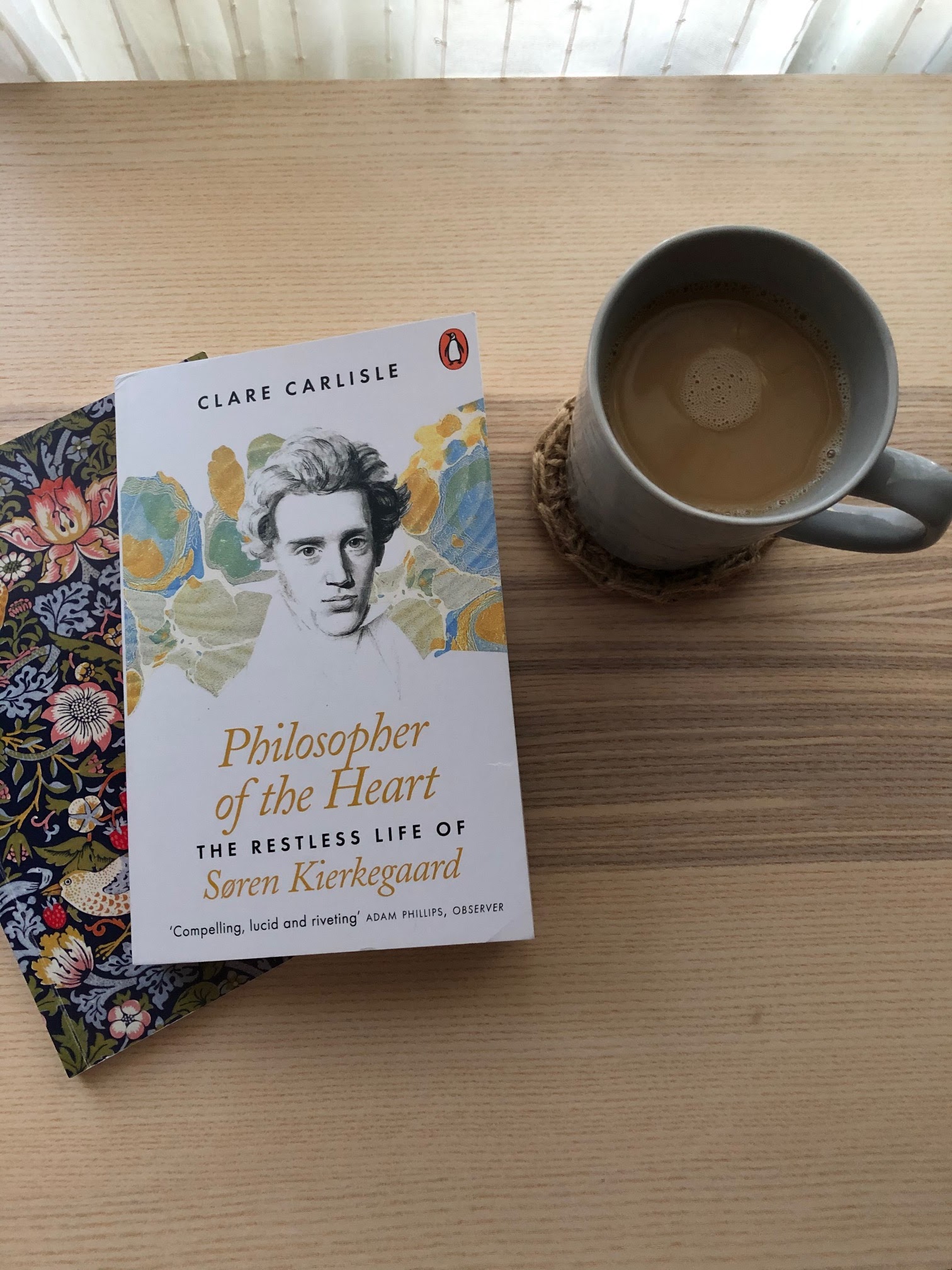
Philosopher of the Heart


I came to understand myself by writing.

- Søren Kierkegaard

I enjoyed reading this biography so much, and the way it was written added a layer of enjoyment. It was not written in the style or format of a traditional biography, which to me can sometimes become trite as the author sometimes feels they need to document every tiny thing. This book was written in a beautiful fluidity which brought us into the mind of Kierkegaard and his thoughts and struggles, using some journal entries and documentation of his behavior as he lived in Copenhagen. We walked with him as he enjoyed his regular long walks around his city. We sat with him at his desk where he hashed out his thoughts, sometimes coming into his house from a walk directly to his desk still in coat and hat to write thoughts down immediately lest they be lost. We rode the train with him as he traveled back from Germany after studying. We gain an outside perspective of him as well as his reaction to various outside perceptions. 

The author Clare Carlisle wrote that "confusion is a fertile soil in which wisdom might grow." This very accurately describes Kierkegaard's approach to his deep thinking. He observed what was going on in his time in his city and country, and he responded to the worldly confusion on how to be a true Christian in the only way he knew how - by writing out pages and pages in his journal, exploring themes he had studied in the known philosophers (like Socrates or Hegel) and then spent much of his time publishing books of discourses addressing what he sees happening in society. 

He was interested in thinking about how to be a true Christian in a society that was "Christian", mixing church and state in which everyone was deemed a Christian as they were a citizen. He was distressed by the complacent, comforting messages that he heard from the Bishop's pulpit. This concerned him, as he believed you cannot be a true Christian without going through the suffering of life, not just coating it with sugar saying that it will be better in days ahead. That doesn't help you grow in wisdom, but causes you to embrace worldly ways. Kierkegaard believed that modern Christianity was leaning too close to worldliness, so he tried to counter this by leaning further in the opposite direction.

Along those lines, Kierkegaard was seeking to be at peace within himself, rather than in those worldly things. He wrote in his journal "..how sad it would be if human beings could only find peace in what lay outside themselves." His words and thoughts sometimes feel trenchant as they cut into the heart of our comforts, and they are still so applicable to our society today. Do we ask the tough questions today or do we just want to zone out with the pleasures of worldly indulgences? Kierkegaard challenges us to seek true divine wisdom as we look more deeply within ourselves to see what path we are going to choose everyday. 

The author writes "In drawing this contrast between divine wisdom and the false wisdom of the world, Paul argues that serving God and pursuing worldly things - including esteem, success, status - are two diverging paths through life: an either/or." This is exactly what Kierkegaard explores.

19 August 2020

How I Read a lot of Books


Within in its depths, this light, I saw, contained,
bound up and gathered in a single book,
the leaves that scatter through the universe.
- Dante

If you talk to me for more than a few minutes you will likely get me to talk about what book or books I am reading or what topic I have been pondering and researching through books. Whilst I explain the story or the topics, I hear so often from others that they wish they read more, and just cannot find the time. They comment that they get bored and fall asleep. Or they cannot focus. 

The importance and benefits of reading spans countless reasons that would go way beyond this tiny post. I could go on for days about how reading good books is the best use of time and how I never regret reading. Reading stretches our imaginations, puts our brains to work in the best and most beneficial ways, and allows us to see through other eyes to learn and grow.

I read 62 books last year, and it was not because I am some great reader or because I have a ton of spare time. On the contrary, actually. I attribute it to the following: 

Making reading a priority - When I talk to people about reading more, I usually ask about if they set a time each day for reading, and they always say no. Most often they leave it for the end of the day, right before bed when they are most tired, and they end up falling asleep. So I ask - if there is something important to you in your life, don't you set aside time to be sure that you give appropriate time to it, to allow it to grow and flourish? My weekends are fully booked. I read for hours, not just a few minutes. Every evening I read. If I get too tired as it gets late and cannot concentrate, then I put the book aside. The book I read at night is not one of my more difficult academic-type books. It is the Dorothy L. Sayers murder mystery that is much lighter reading.

Reading what I enjoy and am passionate about - Don't read books that bore you or are on topics that do not interest you. But do read good books. Read meaningfully and deeply. Read books that have stood the test of time in between newer books. As C.S. Lewis recommended, read a classic in between new, modern books to refresh your perspective. Discover what you are passionate about and read read read. The wonderful thing about reading is the more you read, the more you discover there is to read. One book leads to another, and another. If you love nature, read some books about gardens or trails or different aspects of nature. I've been reading many books recently by John Lewis-Stempel, who writes beautiful prose on woods, trees, and animals in the UK.  

Putting aside distractions - This is one of the biggest hurdles in keeping up with reading and staying focused. All the distractions in our lives steal time from us. Something that gives me control over that is coming to the conclusion that I am in control of those distractions. I can put my phone in the other room and ignore it. I can put my laptop away. I do not watch TV at all, but one could turn it off and leave it off. Whatever else is distracting in your life, find a way to turn it off, or set it aside for the time that you are reading. It's about the conscious effort. It is fully within our power as a choice.

Hopefully something here will help invigorate you if you are one who would like to read more, but cannot seem to find the time. The great consequence of reading is - Once you read more, you will want to read more, and that is a wonder-filled trend to get on. 

13 August 2020

Visits with Kierkegaard


Oh, if men would rightly understand what a beautiful use they could make of their imagination, their acuteness, their ingenuity, their ability to co-ordinate by using it in every possible way to discover an extenuating explanation: then would they increasingly taste one of the most beautiful joys in life; it could become to them a passionate pleasure and need, which would cause them to forget everything else.

- Søren Kierkegaard

Once upon a time, many years ago, in high school and in college, I frequented the Selby Library in Sarasota, mostly to browse the excellent bookshop inside, which sells books at a very affordable price. At some point along the way, I came across this lovely hardback book, A Kierkegaard Anthology. It was $1. At that point, I had only heard of Søren Kierkegaard vaguely somehow, I did not even know. I thought he was a Christian, perhaps, but I did not know much beyond that. But I bought the book.

I thank my younger self for such clairvoyance to buy it. I realize now how providential that casual purchase was. I soon read through many of the selections in this anthology, mystified by the deep theological thoughts that were way over my head, and yet I was drawn to them because I understood something in them. Maybe it was only a few tiny things I understood, but I kept reading, and became an admirer of Kierkegaard's writings.

I have never taken a class in philosophy. So here was my first taste of it with Kierkegaard, and through him Socrates and Hegel. I did not understand all I read. I was confused by the "other authors" of his discourses, which I now know were his way of expressing various opinions and views of a topic at hand without putting his own name to it. Many books he published did not have his name attached for this reason. 

He was a Danish Christian (he lived 1813 - 1855) who saw issues in the Christian society of the Danish life, wondering how one could be a true Christian in a society where everyone was a "Christian". In his case, church and state were one in the same. One had to be baptized in order to become a Danish citizen. He believed that to be a true Christian meant to suffer and go through difficulty and come out the other side, after all, Jesus goes before us in all our suffering. He believed the sermons being preached at his church in Copenhagen were too comforting and watered down, leading everyone in society to be complacent in their Christianity. Sound somewhat familiar? Isn't our society running along the same lines?

I always find myself coming back to visit Kierkegaard every now and then. Something I read will remind me of something he wrote and I will visit with him again. I have so often revisited the wonderful anthology, or some of his other books. His Works of Love captivated my idea of what it means to love others. And a new biography, Philosopher of the Heart, is absolutely engaging and beautifully written. I am reading it now, and enjoying it so very much. Not only am I learning much about the Danish Christian world, but also much more deeply into why he wrote what he did, and what inspired him. I will leave that for another post.

We are all so much more apt to think about discovering evil than about discovering good. - SK

07 August 2020

A Reading from...Selador


As I work on writing the second volume of Selador, I thought it would be fun to revisit the first book, Selador: The Book of Time. If you have read it, I hope that it filled some hours with enjoyable escape to another realm with Nella and her friends in the village of Selador. 

In the second book, the story continues with Nella. Find out what happens next (I'll be vague so I do not spoil anything from the first book). Nella must come to terms with the power she wields as an entry-writer in The Book of Time, and the consequences of that power that she never wanted. Her friendships deepen with Master Nolan, Lady Kira, and Lady Cora. But a threat now comes from the city of Stros.

If you would like to purchase Selador: The Book of Time on Amazon, here's the link!

Stay tuned for more updates on the second book (including the title!). I have been striving to use my time at home productively by getting a lot of writing done. That is a joyful thing, to me, and I hope that you will agree when you read this book I have been working on. I say "work", but truly it is a joy to write this story, as it explores some deep truths that I am passionate about exploring. Things that I enjoy discovering by way of other writers. I find that what you read is what you think. 

I will post some sneak peaks at the new book as I continue to work on it, but until then, here is a short reading from Selador: The Book of Time, just for fun.


05 August 2020

Little Black Penguins


The light of truth that feeds them with its peace will never let their feet be turned away.
- Dante

I started collecting a few of these mini-sized Penguin Classics a few years ago when I saw them for the first time whilst book shopping in England. I forget exactly where I first saw them, probably in Oxford where I tend to do most of my book shopping. These little books are a great way to get a taste of an author, as they publish either a collection of poems for a poet, some short stories, or snippets from lesser known works by an author. The Dostoyevsky, for example, White Nights, is a lesser known shorter story from the great writer, and I enjoyed reading this very early work of his.

The little Penguins are a great way to explore different authors, or re-visit some favourites, and get a diverse reading experience. I do not think I would have ever known or read The Book of Tea, but I enjoyed that one a lot (as a lover of tea), and some authors I am curious about but have not read before are available here in little books, which fit perfectly in any bag by the way.

The Dante book I recently received, and on the front is my favourite quote from The Divine Comedy, from the last book, Paradiso, and the book itself has a collection of Cantos from the final book in the series, which was enjoyable to read, as it is a different translation from what I have read by Dorothy L. Sayers.

Wishing you happy explorations as you find new books to read, or seek out authors you have not read, to deepen your knowledge, appreciate seeing the world through other's eyes, and letting your imagination run.