02 December 2021

Autumn Bordering Winter


Autumn Bordering Winter

Oh let them fall
All the leaves all
Falling, papery thin
Hues of myriad I saw
Whilst in a state of awe
I watch them fall
With a half-floating tilt
They tip their tiny hats
As they gracefully glide
For a wistful moment, slide,
Slice, and saw, through air.
A nature show for all
That display of beauty in colour
Short-lived and transient
Soothing a salty temperament
As reminders of a seasonal glow
Worth lingering moments to know
Such secrets of nature, a clear call
To gather every one and all
To a conference of the leaves
Before bordering winter as it may please
Comes swiftly like a wind
Can we see it all again? 
Once the dancing leaves fall
They do not look back at all.

Special thanks to the leaves of Savannah, Georgia this last week for their display of beauty and colour. To allow my feet to shuffle amidst them and see their late season glory. It was a gift to my Autumn loving, chilly weather needing soul.

24 November 2021

What Does Thankful Look Like?


The sky is streaked with windswept brushstrokes in a monotone grey. The air is calm, but above our heads the chilly air moves with speed. My body feels the cold, and I am thankful for the sweater that warms my arms. I look around and appreciate how the greyish, subdued morning light awakens different scenes of the day. The leaves on the trees have a muted, autumnal hue. The reflection on the lake is like glass, revealing another world on the other side of the water's surface in my imagination.

A few days later, an opposite scene greets me with a blue-hued sky reflecting in a blue tinted lake. Not one wisp of cloud dots the perfectly smooth sky. The air feels warmer. A slight breeze dances over the lake water and the green leaves are vibrant.

Both days I was filled with a thankful heart. Much as I prefer the grey scale sky because it is more interesting to me, I look at each day and appreciate what it is giving me. It is a gift I can choose to enjoy. It is not about circumstance - it's a posture of the heart. No matter what the day looks like I can choose to let thankfulness blanket my soul. 

Both/And not Either/Or

In 1 Thessalonians 5:18 we are reminded to - 

... give thanks in all circumstances; for this is God’s will for you in Christ Jesus.

These photos were taken just a few days apart on my way to work. I am blessed to have this view every single day. Something I love is how it looks different every morning. Whether by the light cast down from the sky, by the wind chopping up some waves, by the wildlife (swans, geese, ducks, pelicans), and by the activity of people who are walking or taking some quiet time. 

As we celebrate a time of Thanksgiving in our American culture, it might be different from recent years. Families might be scattered, travel might look different, it might be quieter than usual. But our lives are different so we are still dealing with what that looks like. My hope is that we will all be able to be thankful in all circumstances, even amidst the strangeness, because I believe that is the way to see the goodness of God in every day and to foster a thankful heart.

17 November 2021

You're So Medieval


"When overdone, true virtue wanes.
Indulgence, surplus & excess
do not equate to more, but less,
& what goes on relentlessly
infuriates eventually."
The only everlasting good
is found within the realm of God:
its basket constantly provides
yet stays replenished to all sides.
God's wondrous empire knows no end,
forever giving, never spent.

- Lines 350-362

A narrator overhears an owl and a nightingale debating in the trees. They speak as if they are human, which is never explained in the poem, and other than referencing some bird-specific aspects and characteristics, they could be any two humans having a debate at a coffee shop. Within these lines I heard two humans disagreeing and differing in their ideas on morality, personality, habits, and particular ways of living. Two different cultures or personalities.

The dating of this poem is not fully determined. Somewhere between 1189 and 1279 is the range. The author is unknown, though the original poem mentions Master Nicholas of Guildford, who is the person of sound judgement in the poem. This would traditionally be the author (Simon Armitage, the poet laureate and translator of the original in this new version, cleverly inserts himself into this translation as the person of sound judgement). Even the location is unclear (somewhere in southern or southwest England?)

Why do I appreciate the translations that Simon Armitage has done? He makes Middle English Medieval poems approachable and able to be discussed in our modern day. We do not have to be a scholar to discuss the themes and topics being addressed in the poems he has translated (yes, translated from English to English - but can you understand all the nuances and obscure words of Middle English?).

Something else I enjoy is even though it is a translation, and not Simon's original poem, his translation adds his own personality into the verbiage, and I can hear his poetic voice in these lines. I really enjoy these Medieval poems translated so we can explore them today. This is a poem so Medieval and yet now so easy to read and enjoy with modern minds.

But what is the purpose or meaning of the poem? It is unclear, and yet I sense that these two different creatures who cannot seem to understand one another or agree on anything is a pathway for us to see how we should be willing to listen to others who do not share our beliefs and practices, or who have different personalities, to be able to practice good listening and empathy with one another, even amidst debate. Maybe there are things an owl can learn from a nightingale and vice versa? Maybe they will stop arguing one day and see that.

10 November 2021

Bookstack


And I have felt
A presence that disturbs me with the joy
Of elevated thoughts; a sense sublime
Of something far more deeply interfused...

- William Wordsworth

What books have you been reading this autumn?

If I tried to hold all the books I have read, my arm would be crushed.

Keeping with my goal of reading a new classic each month (a classic I have never read), I am also intertwining poetry and mystery at the same time. This is just a little stack of the books I have recently finished, books that have continued to stay in my mind since closing the cover on the last page.

My poetry book lately has been the collaboration of Wordsworth and Coleridge in their Lyrical Ballads, published first in 1798, which is a bit of an oxymoron, as something lyrical being emotional and a ballad being structured and storytelling. And yet their revolutionary poetry established the romantic poetry of the 1800s incorporating emotion and feeling through nature and story. This collection was the start of a shift in English poetry, with many other poets to come along following their pen marks.

On the theme of poetry, Simon Armitage's collected Oxford lectures, that he gave whilst he was the professor of poetry (a 4 year term), are a thoughtful, expanding meditation on poetry in the modern view, using the old and new to fuse into the generative environment we have now. I always enjoy reading or listening to Simon's thoughts on poetry and our modern age.

Murder mysteries in the spirit of the golden age of mysteries (Agatha Christie, Dorothy L. Sayers) are always appealing to me. Such books from the 1920's - 1950's are dubbed cosy murder mysteries, which may seem contradicting, but I totally get it. What is cosy about murder? It is about getting lost in a case, losing yourself in solving that mystery, and in some sense they are fantasy books because the murder and the situation is so fantastical it is an escape from the everyday. I've always liked solving mysteries and finding clues along the way. The Murder of Roger Ackroyd was such a good murder mystery with a general classic look at first glance, but one that throws people way off at the end. The Devil and the Dark Water was written in this kind of tradition of mystery, but written today with a modern voice. This story takes on a historical aspect as well, taking place in the 1640s. 

My classic of the month was The Mayor of Casterbridge by Thomas Hardy. It was my $1 find at a library sale a few months ago. I had not read any books by Hardy yet, and I will say his prose descriptions on nature and people is beautiful, yet his characters are set-up for doom. There is a sense of futility of life and the mishaps and bad decisions made over time will catch-up to you. When I felt some hope of a character looking to redeem their past, they would turn back like a magnet, setting up their future doom. There were so many instances of wanting the characters to choose differently, which reminds me that every choice we make will impact our future (good or ill, loving or cruel). That is a realistic thought to meditate on - consequence.

03 November 2021

He rose the morrow morn


 He went, like one that hath been stunn'd 

And is of sense forlorn:

A sadder and a wiser man

He rose the morrow morn.

- Samuel Taylor Coleridge

To be reflective and meditative is to give yourself the space to grow into wisdom. The air of melancholy may accompany such depths, but is not always linked to be a replica of the word, depressed, but it can hold a sadness that lingers because of story, life, the world. We can feel the sadness in the state of our planet, our divisive culture, the negative views/actions of others, and the changes it all may cause which will shape our future.

We can grow in wisdom and feel melancholic about it as it can be a sobering experience. We can dwell there to process through it all. In my mind, I always need to let my thoughts walk around. It is not that we look for a state of melancholy, but it comes to find us, and when it does, it can be a catalyst for development and creativity. Many of the best poets and writers wrote when feeling downcast. I myself have done the same, and if I have been able to embrace what it is, that part of the experience of being human, my words come flowing from a deeper, more meaningful place.

Upon hearing a tale of lesson and loss, like the ancient mariner in the quote above (from that marvelous poem "The Rime of the Ancient Mariner"), one can walk away grateful, wiser, and melancholy all the same, feeling like one just dipped into a tale much bigger than themselves.

When we see things are much more complex than just our own struggles, a sense of thoughtful melancholy can sweep over the atmosphere, not because one is sad, but because the state out of control of the big things and the little influence we have. But we can choose to do good in even the small ways we have at our fingertips.

If you are interested in this topic, I will be exploring it more. I have been diving into the new exhibit (and hope to visit in person) at the Bodleian Library on The Anatomy of Melancholy, the 400 year old book written by Robert Burton. 

27 October 2021

Almost Autumn


We are in the 'almost autumn atmosphere'. A time caught in the anticipation of cool breezes and shortening days. You may wish for longer days again, where the sun shines late into the dusk hours. But lessened light gives me anchors of hope for the coming seasons. 

Whispers rustle amongst the branches outside my window that cooler air is soon to arrive. Even recently the gentle morning air reveals the hushed tones - the leaves noting a change in hue pondering ‘will it come’? Like a secret to be revealed, holding on the edge of anticipation until it comes.

I awaken every morning with the hope that a swift chill swept in overnight and suddenly I will need to don a sweater, but alas, not yet. Do you hang onto the months of jolly sunshine and rainy afternoons? It reminds me of the need we have for seasons - to have a cyclical reminder which comes around every year that change comes like tides of the seas - a rise and fall natural to our world yet continuing on without consulting the calendar. 

Do we ever give much thought as to why seasons are beneficial for us? From a contentedness standpoint, seasons help us appreciate the time of year we love the most, by experiencing its opposite. I gush endlessly about Autumn and Winter because it is the opposite of Summer. I write more poems that are drawn out by the colder seasons because they inspire me and it is a change from what it was for so long. 

I remember when I was a child in elementary school the thrill of feeling the season change. Suddenly I was sent off to school with a little jacket or sweater, and I did not fully understand why because sometimes it was not cold to me (children never feel that cold, do they?) but it thrilled me all the same because something was changing in the air. Even in Florida we felt a shift, albeit subtle, and then suddenly we will get a welcomed swoop of chilly air. I have many memories of heading off to school with a sweater and feeling so very happy about it because it felt special and different. It held an element of mystery and wonder to me.

And I still feel the same. I guess we are all still children in the core of our hearts, aren't we?

20 October 2021

October Books


Tis the season for all the mysterious vibes, the cosy candles, the long walks along leaf-strewn paths, and the feeling of change in the air. Even if I am mostly pretending until the weather cooperates. One must be patient for the lovely gifts of the autumn season to come. This is by no means an exhaustive list of books I have read this month, but a few that I have finished recently.

Dracula by Bram Stoker
This is a classic I had never read, and I thought it was time, especially as October started. I decided to set a task to read a classic each month that I haven't read before. If you have any recommendations I would love to hear them! Dracula is an interesting tale, well known to some extent, but reading it at last I understand what happens in the story - how Count Dracula is visited in his castle deep in Transylvania by an English attorney, Jonathan Harker, who learns the dark secrets of Dracula over his long stay. Back in England, something strange happens in London and Whitby. A strange presence emerges. Dracula has come over to England. His first victim is close to Jonathan Harker and his wife Mina. But who is going to stop him?

Walking the Invisible by Michael Stewart
A new book released that I immediately wanted to get, following the various walks and locations associated with the Brontë family. They were known for their long walks through the moors and windy landscapes of rugged beauty and danger. I love to learn about all things related to the Brontë family. Each of the siblings had their own talents in writing, and learning about their home, their landscape, and all the things that inspired them is key to understanding and appreciating their books and poems in the best way. It would be so fun to walk some of these paths outlined in the book to feel immersed in the minds of the Brontës - there is much that has not changed since their time in the early 1800s. 

The Murder of Roger Ackroyd by Agatha Christie
What an interesting case taken on by Hercule Poirot. He is taken away from his "retirement" and gardening in a small English village, to solve the case of Roger Ackroyd's murder. As usual, there are many suspects to investigate, and Poirot is always a few steps ahead of us in knowing things. Of course, using his little grey cells in his brain, he sees much more than we do at the surface. When everything seems like it is clear, when all evidence points to one particular person, it cannot be that simple. And it's not.

David's Crown: Sounding the Psalms by Malcolm Guite
Malcolm wrote a reflective poem based on each Psalm, set in a poetic style of a corona, meaning the circular nature is the last line of each poem is the first line in the next poem. I have been reading this collection for a couple months, and just finished it. Usually I read two poems each morning with my coffee and journaling (sometimes more). I admire his poetry so much (as well as his talks, YouTube videos, and books), as he has the gift of language that is accessible in today's modern world, yet it draws on all the old ways of writing poetry - sticking to the meter and structure which actually opens the capacity of the reader in ways free verse never could. He is certainly one of the most talented poets alive today.

13 October 2021

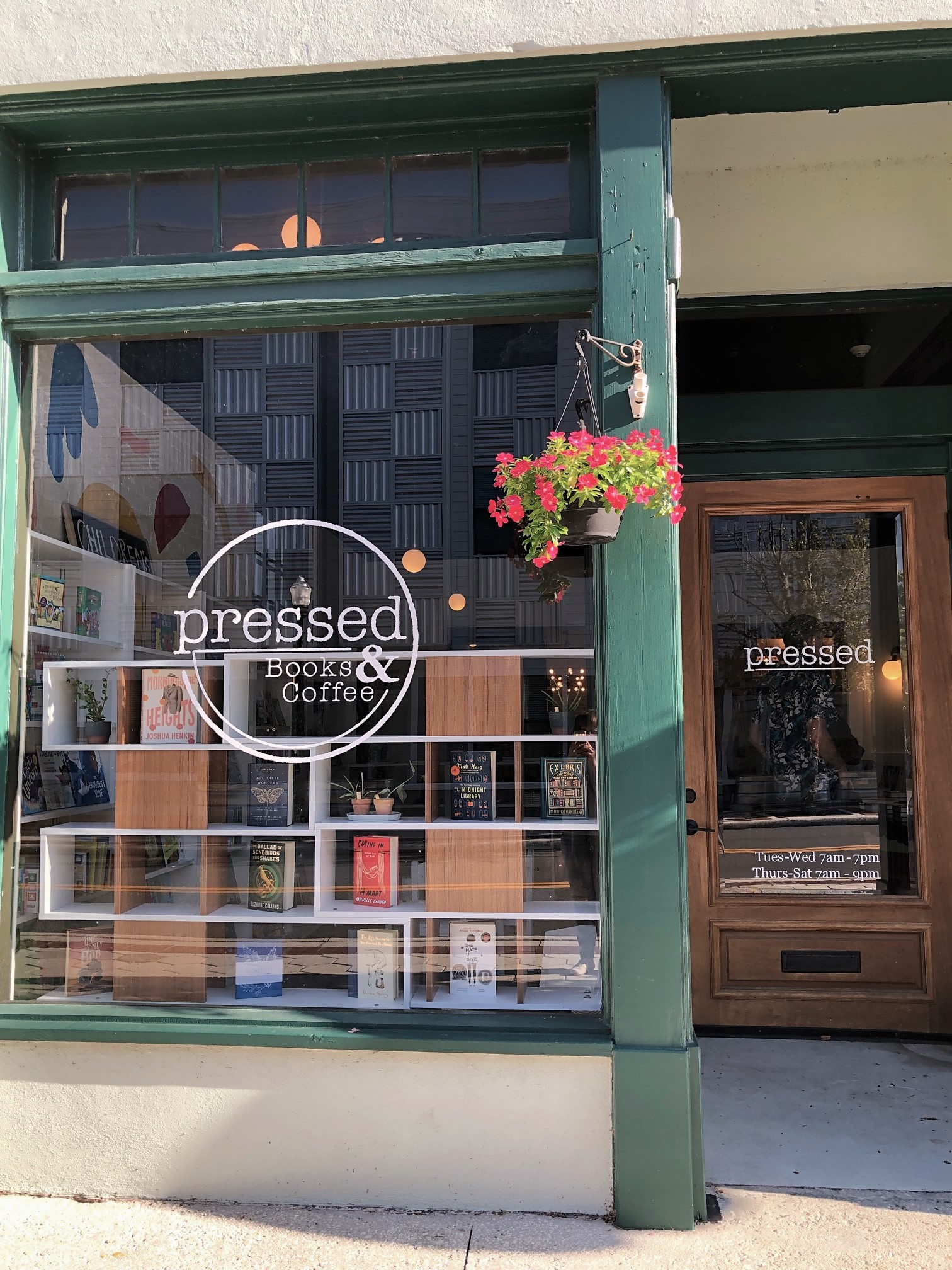
Selador Available in Pressed Books & Coffee!


Am I dreaming? I am living in a surreal moment - my books are now available on the bookshelves of the cute local independent bookshop downtown, Pressed Books & Coffee! I hope that my books are having fun hanging out with the other books as they wait to be picked up.

I am beyond grateful to the lovely owner, Christina, who was excited to stock my books. This feels so undeserved, honestly. My tiny writings get to share the shelves with all these wonderful books? 

The goal of a writer, of course is to share their writing with the world, but it is a somewhat scary thing to do. Like an artist, something creative involves a lot of personal effort and work. It is something close and dear to the heart of the creator, and to see if out there rides the line of excitement and nerves.

If you are local, please go visit Pressed Books & Coffee. It is a lovely little shop stocking new releases, paperbacks, children's, teens, business, non-fiction, used books, gifts, and they have a coffee/tea bar serving all kinds of coffees (lavender latte is my current go-to) and teas, as well as fresh baked goods. In each section they have "Lkld Local" for all the local authors who have books. It's such a delight to see it - as they are unique and cannot be found in other bookshops!

If you are not local and would like to purchase my books, they are available on Amazon HERE and HERE.

07 October 2021

Autumnal Strange Unearthly Longings


In the hills on autumn evenings when
We seem to hear the horns of elfland blowing
And strange unearthly longings draw us in.

- Malcolm Guite (from a poetic reflection on Psalm 67)

The breezy winds are coming in from far away places, rustling the leaves that cling to the branches. Rainy season has left behind a slight feeling that there is a change in the air, however slow it may be, it is coming. It is drawing us in with the voice of the north wind.

These invoking words and images of faerie lands forlorn and places where the elf may dwell leave me aching for that which is deeper, more alive, more awakened to itself. Maybe that seems in opposition of the autumn season as the leaves fall to the ground leaving bare branches and after harvests are reaped the grasses change their bright hues to a toned down hay. But this is exactly what awakens in me the wonders. This kind of seasonal shift resonates with me in fostering more awareness of the imaginary, the inspiring, the myth and legend. This kind of feeling arises best where there are glimpses of where faerie might dwell. The thin places in this world that link to another place. It seems more possible as the land shifts and the trees change. There might be uncovered or revealed some ancient path or stone walkway that could not be seen before. Where does it lead?

Perhaps my imagination is getting carried away, or perhaps not. Maybe that is what we need from time to time. To lose ourselves in a story or myth. To be immersed in something bigger than ourselves, reminding us that even in the everyday there is a bit of magic that can be discovered. I am looking forward to these days ahead.

05 October 2021

On Writing in Books


Squiggles.
Arrows.
Marks.
Underlines.
Writing.
In books.

Does the idea make you shudder? 
Or does it invoke interest and engagement?

I like to think that when we read we are in a kind of dialogue with the author. We are reading their thoughts, their story, and ideas, and sometimes I want to talk with them in the margins. I might agree and just add a note, or link it to something else I read. I might disagree, and write a counter point.

Or I might underline or mark a paragraph that I will invariably return to later. It makes it easier to find. I so often flip through books to re-read or just dip into, re-visiting my favourite passages to ponder or consider again. 

An example - Many people have asked me over the years why I do not just check out books at the library. That is a very simple answer with many layers. Because I cannot revisit them later whenever I get a sudden recollection of a passage, essay, or book I want to re-read. Because I cannot write in library books. Because I like to be able to sit at my desk and be reminded of a passage, stand up, search my bookshelves, and pull out the C.S. Lewis or Owen Barfield book I was thinking about (I literally just did this today). I will flip through that book and find the passage I marked 10 years earlier (and maybe re-read some sections). I do this so very often, it is the most natural thing in the world to me. This is why my home is a library. It always will be.

All these things are engaging with the book, the ideas, the author's perspective, and remembering what I read to a deeper degree because all of this causes me to slow down in my reading. Rather than speeding through a book, if I am writing in it, or even just underlining, I am reading more thoughtfully and slowly. Thereby retaining the information much more than a quick read would. It also means I will likely return to it again later, setting it to dwell even more deeply into my psyche. 

Side note - I know many people like to keep their books pristine, but to that I ask, why? Unless you want to re-sell them? I don't. For most of us, our books will not be kept in a museum, and if they are, it will likely be of interest to whoever reviews your books what you wrote in them and how you engaged with the books. What I would do to be able to browse through the library of C.S. Lewis to see what he wrote in his books. To me, it would be interesting to see what he thought as he read. J.R.R. Tolkien wrote and doodled on his everyday crossword pages (I know that's not books), which are now kept at the Bodleian Library and have been put on display in an exhibit to show his creative energies.

For even more engagement with books, I write out favourite quotes in my journal and commonplace book. But that is a digression as this is a musing about writing in the books themselves, to which I think I made my meandering point.