02 February 2022

Ah, Bitter Chill it Was!


St. Agnes' Eve - Ah, bitter chill it was!
The owl, for all his feathers, was a-cold;
The hare limped trembling through the frozen grass,
And silent was the flock in woolly fold:
Numb were the Beadsman's fingers, while he told
His rosary, and while his frosted breath,
Like pious incense from a censer old,
Seemed taking flight for heaven, without a death,
Past the sweet Virgin's picture, while his prayer he saith.

- from "The Eve of St. Agnes", John Keats

Reading these lines makes you feel cold, doesn't it? 
I love the image of the owl, for all his feathers, still a-cold. I can see him shivering as he sits perched on the tree limb dozens of feet above the ground, looking out across the landscape, perhaps catching a glimpse of the hare who is trembling through the frozen grass, trying to get to his warm burrow. The frosty, crunchy grass seems frozen in time as the evening advances.

Ah, John Keats, who so beautifully mingles the spiritual and the temporal in his poetry, I read again this poem that invites me to imagine a medieval landscape of trials and bitter chill, and an introduction of the mythical.  This is where my heart and soul can expand beyond the norm of the everyday, and into the relish of the imaginative story that is bigger and older than me. It has much to tell, even in a microcosmic manner. Two young souls from challenging opposing families risk their lives to run away on the bitter cold, mystical night of St. Agnes' Eve, where the legend presents an opportunity.

I have been soaking up these cold, wintry, grey days. Even though I might shiver and for all my blankets and sweaters feel a-cold, I live for these days as they are so rare in Florida, and feel like a special treat to me. I realize that my love of winter and the grey clouded days we have had recently go against the general consensus of enjoyment out there, so if you think I am mad, I know. Most people do. I accept that and challenge you to try to see it from another angle, just as I need to see the summer sun and heat from another angle in those long, arduous months. 

A few days ago there was frost on my car and on the grass lawns of all my neighbors. I could not help but smile. The snowy dew was magical to me. I wanted to take a walk and linger with the scenes before it melted away a short time later. When I see things like that, especially in nature, where the changeable stance is that of the unpredictable, I am swept into the imaginative world mingled with my own. The two worlds collide, which makes the magic that I see.  

19 January 2022

Musing on Why Dante Matters


Over a cup and saucer of coffee (refilled a few times), I am reading the academic voiced book Why Dante Matters. Truthfully, I already know the answer, for Dante is a great master of delving into the human heart and reaction to love, placed within the cosmic backdrop of the seven heavens of Medieval cosmology, which is absolutely fascinating to me.

You say, "I discern clearly what I hear; but for me darkling still is why God should have chosen this means of our redemption." This decree, brother, lies buried from the eyes of each and ever one of those spirits less than adult in the flame of love."

- Paradiso VII. 55-60

Dante died 700 years ago (1321), and I find him to be more relevant and deeply engaging to the longings in our hearts than most any modern writer trying to sort out the meanings of love and the cosmos. He combines faith and science as they should be, co-mingled as colleagues and friends in the vast depth we study of God to try to understand just an ounce of God's love, which moves everything.

I think I am deeply moved by this concept, thanks to the Medieval aspects and beliefs. Though a geocentric cosmos was later proved to be false, the same ideas can all play out, with all the mystery included about how the plants move in circles around a centre and how they move in time with Love Himself, the Maker and the Intelligence behind it all.

To me, that knowledge and imaginative vision of the heavenly bodies and their organized system that allows us to live here on a planet with the perfect conditions gives me utmost assurance in God being who He says He is. No force could create and sustain a complex system of the cosmos other than a Creator, an intelligent mind. It is pretty darn clear to me, and to a lot of science today. There should be no bifurcation of science and faith - right there present in both is myriad beautiful examples of God.

Dante helps me see this all from his perspective from the 1300's where the world was a different place both in history and science. It is astounding how profound his knowledge of the cosmos and of God is, from his time in Italy (and exile) in the 1300's. That was all more than 700 years ago. Yet today there are still many arguments that try to provoke others to believe that there can be no God and all of this is a complete fluke, an accident, and we have no meaning or purpose.

How could anyone wake up and look at the dawn sky with multi-coloured glowing orbs of light emerging over the sleepy horizon as our planet turns, and not feel the awe and wonder of creation, and attribute that to a higher being/intelligence? Even as we sub-create, it is all pointing still toward the One Creator. We were made to sub-create. God gave us minds to wonder, learn, seek out knowledge, search for clues in the mystery, and aim to create as well. Since we are made in His image, perhaps that is why we have this hidden desire to sub-create and use our imaginations.

"O beloved of the first lover, O divine one," said I then "whose speech so floods and warms me such that I am ever more quickened, my affection for all its depth is scarce sufficient to render you grace for grace..."

- Paradiso IV.118-32

This book was published last year, the 700 year anniversary of Dante's death,  analyzing three major works of Dante, the Vita Nova, Convivio, and Commedia. With extensive quotes from each of these volumes and textual analysis, it is rather a studious text, like being in a Dante course in graduate school. I rather enjoyed the depth, knowing that still much is over my head, but I am always open to being out of my depth, for there is room to grow and learn. I am very eager to read Vita Nova and Convivio now, as those are two works I have not yet read. I think this book left open for me a door that I may now enter into with some better knowledge of what Dante is conveying in his works.

What, then, we need to understand is this, that, for the reason shown above, everything has its own proper love. Just as simple bodies have within them a natural love for their proper place, which is why earth is always drawn to its centre, and just as fire has a natural love for the sphere above us bordering that of the Moon, and so always rises towards it, so the primary compound bodies, the minerals, have a love for the place where they are created, and where they grow and whence they derive vigour and energy; thus we find that  a magnet always acquires its power from the place when it comes.

- Convivio III.iii

12 January 2022

Taking Note of Smart Notes


Having a clear structure to work in is completely different from making plans about something.

- Sӧnke Ahrens

I would be remiss not to jot out my notes from this book on taking smart notes that I just finished. This book was not just for students and writers. There are many elements provided in these pages that I can incorporate into all aspects of my life, including work and writing. Do you takes notes? How to you organize? I am always up for learning, so here are my brief notes taken for myself to review again, after I turned the last page.

Keep things as simple as possible. 

Assemble notes and ideas as drafts in notebooks or on napkins (whatever works or is at hand). These are temporary resources for those flash ideas you want to get out onto an external memory bank. Writing is not the main work - reading, thinking, and understanding is. To fully understand, you need to translate what you read into your own words, as you write it out you are forced to think about it and weigh it against what you know already.

Instead of collecting ideas, your aim should be to develop ideas and arguments. Keeping a growth mindset, keen to look at changing for the better, which looks at inward development, rather than looking to receive praise as an outward reward. Know an essential part of learning is the feedback loop.

 Seek out feedback, don't avoid it. And note that multi-tasking drains your ability to shift, and it delays your good focus. At the same time, we need to be flexible in ways that keep us concentrating if something comes along that makes you depart from it.

Let your thoughts linger. Sometimes your brain will work it out in the downtime when it's out of focus. A break will allow you to learn better by letting your brain the chance to process and move information into the long-term memory so there is space for new information.

Read with a pen in hand. If you know me, this is a given. Have a dialogue with the book in the margins. Take notes by hand. There is research that shows how the act of writing out notes by hand actually helps you learn and understand more. Since the hand can't write as fast as your typing, you are forced to think about what you are encountering, and to write the main points. Of course, this takes work, but as it is said, the one who does the work does the learning.

A wise person is one who can make sense of things by drawing from many resources of interpretation. Some tips include:

1. Pay attention to what you want to remember.

2. Properly encode info you want to keep, with cues that can help you remember.

3. Practice recall.

Ultimately, if you want to follow the book, you would start a organizational system with the notes on index cards and writing in your own words to build future projects. 

07 January 2022

Index, A Bookish Review of the


...the index presents a perfectly sized nook for the deployment of discreet snark.

Index, A History of the
By Dennis Duncan


I finished reading Index, A History of the last night and it was delightful. I always find bookish history interesting but this one added some friendly intrigue to the tales, with some added doses of snark from history. History does have some funny tales to be told. 

I am not sure that indexes are used as much today except by scholars, or thought about in much depth (being that there was no history of the index, Dennis Duncan had to fill that gap and write this book), but it does actually influence us every single day because chances are you Google something most everyday, and what you access when you type in your inquiry into the Google search bar is Google's index. Fascinating that the tech giant of all information out there in the web world uses a system invented in the 1230s. I love that. I love learning how ancient and/or medieval systems or tools are still being used today. That the physical book and its included search engines (the indexes - and yes the plural is indexes, not indices. Indices are for mathematics, and indexes are found at the back of books. You can blame Shakespeare for this usage if you want to argue.) are relevant and still used now, perhaps in varying capacities, but still using the original invention.

The index, I learned, was a place where occasionally in history an editor would insert some objection or snarky comment about the contents of the book, by writing entries for subjects with an added personal commentary attached (such as adding an Index to Tears into a poorly written highly sentimental short novel, whereby listing all the 50-60 times a character would suddenly burst into tears). 

The index works best when created with a human mind, rather than a computer. A subject index is what people would use an index for, such as to look up forgiveness or mercy in relation to finding the story of the Prodigal Son in Scripture. A word for word index (or concordance) that a computer would create would have no connection between the concepts of forgiveness and mercy (words not actually used in the Biblical narrative) and someone would be out of luck in searching for it. But if a human creates a subject index, they would know to include the story of the Prodigal Son under the subjects of forgiveness and mercy in anticipation of someone possibly wanting to look that up where those examples might be.

I loved learning about medieval broken links. As the copied manuscripts ranged in different sized paper and books from their originals, the pagination changed and the index often would point to the wrong page if not updated to correct the references. And how astounding that in this modern day of Kindle and electronic books, we could have a similar issue as the pages can be enlarged/expanded beyond the borders, or fonts could be changed, thereby possibly causing a post modern broken link.

Fiction is usually not indexed (as we all probably know, usually it's non-fiction books that have indexes at the back), except in a few instances - my favourite of which is of course Lewis Carroll. Leave it to him to add whimsy to the humble, mundane index. I can't help but laugh and smile at the logic and fun he provokes in me by creating such index entries as  --

General, Things in, 25

Ideas upon ink, 73

In General, Things, 25

Ink, Ideas upon, 73

Milk, Musings on, 61

Musings on Milk, 61

On Milk Musings, 61

Things in general, 25


There are many more entries in the index, but I just pulled out a few of the favourites. The wit is pure delight. What fun it is to play with words. One huge reason why I love Lewis Carroll so much.

So, get to know your bookish history, friends, and get ready to enjoy every step of that journey.

03 January 2022

2021 Bookish Notes


Wrapping up the year 2021 means a bit of reflection time. It has been an amazing year of reading this year, and I loved putting together this little listing of some "best of" books just for fun. I didn't even get all the books in the photo. the tower would be much higher. I am very much looking forward to more wonderful reading in 2022!

What books offered fodder for thinking deeply?

The Divine Comedy: Hell, by Dante  

Meditations, by Marcus Aurelius 

The Letters of Dorothy L. Sayers  (1899 - 1936) 

Lifting the Veil, by Malcolm Guite 

What books were so good they should be read again?

The Tenant of Wildfell Hall, by Anne Brontë

The Feast, by Margaret Kennedy

What books were fascinating studies of nature?

Entangled Life, by Merlin Sheldrake 

Underland, by Robert McFarlane 

Best books of total escapes into another imagined world?

Piranesi, by Susanna Clarke

A Winter's Promise, by Christelle Dabos  

Best book of essays?

A Vertical Art: Oxford Lectures, by Simon Armitage 
 
Best books that made me laugh?

Very Good, Jeeves!, by P.G. Wodehouse 

The Man Who Knew Too Much, by G.K. Chesterton 

Best mystery books?

Peril at End House, by Agatha Christie 

Murder Must Advertise, by Dorothy L. Sayers 

The Murder of Roger Ackroyd, by Agatha Christie

The 7 1/2 Deaths of Evelyn Hardcastle, by Stuart Turton 

Best epic book (that I would love to re-read)?

Jonathan Strange & Mr. Norrell, by Susanna Clarke 

Best theology book?

Repetition and Philosophical Crumbs, by Søren Kierkegaard 

Best poetry books?

David's Crown, by Malcolm Guite

The Owl and the Nightingale, newly translated by Simon Armitage 

24 December 2021

Christmas - The Answer to the Riddles


God chose what is low and despised in the world, even things that are not, to bring to nothing things that are, so that no human being might boast in the presence of God.

1 Corinthians 1:28-29

Christmas can be so commercialized and focused on the gifts and the selfish wants. The emphasis is so engrained in us we barely notice it. Something missing is the humility and joy of simplicity of Christmas. We may have in our minds the scene  - a neatly tucked baby in a bed of hay. Gentle goats and sheep surrounding the bed. Mary calm and peaceful. Joseph standing assertively, watching keenly. Whether Jesus was in a bed of hay or a blow up air mattress, it was a humble beginning.

That is the point.

There is more joy to be had in the simple, humble things of life. It does not need to be filled with frills and luxury. Yet we have made that an essential piece, and it tends to make things more complicated. Our earthly perspective has done so. Jesus shows us our views are quite tilted, in fact, upside down from that of the heavenly realm. What we deem important in this earthly life is sometimes not what matters eternally. There is something deeper He wants us to see, but we have to be willing to clear our vision of the worldly things and the hold they have on us.

It is difficult to clear our vision because we know the story so well.

Let's look at an alternate view to freshen our Christmas views - Merry Christmas!

The Man Born to be King, by Dorothy L. Sayers
Play-cycle Published 1943

Caspar: Alas! the more we know, the less we understand life. Doubts make us afraid to act, and much learning dries the heart. And the riddle that torments the world is this: Shall Wisdom and Love live together at last, when the promised Kingdom comes?

Melchior: We are rulers, and we see that what men need most is good government, with freedom and order. But order puts fetters on freedom, and freedom rebels against order, so that love and power are always at war together. And the riddle that torments the world is this: Shall Power and Love dwell together at last, when the promised Kingdom comes?

Balthazar: I speak for a sorrowful people - for the ignorant and the poor. We rise up to labour and lie down to sleep, and night is only a pause between one burden and another. Fear is our daily companion - the fear of want, the fear of war, the fear of cruel death, and of still more cruel life. But all this we could bear if we knew that we did not suffer in vain; that God was beside us in the struggle, sharing the miseries of His own world. For the riddle that torments the world is this: Shall Sorrow and Love be reconciled at last, when the promised Kingdom comes?

Mary: These are very difficult questions - but with me, you see, it is like this. When the Angel's message came to me, the Lord put a song in my heart. I suddenly saw that wealth and cleverness were nothing to God - no one is too unimportant to be His friend. That was the thought that came to me, because of the thing that happened to me. I am quite humbly born, yet the Power of God came upon me; very foolish and unlearned, yet the Word of God was spoken to me; and I was in deep distress, when by Baby was born and filled my life with love. So I know very well that Wisdom and Power and Sorrow can live together with Love; and for me, the Child in my arms is the answer to all the riddles.

22 December 2021

On Discipleship


Why is discipleship important?

- We do not know it all

- We forget what we think we know

- We have blind spots in our modernity (read the old books!)

- We have the power to influence and encourage others to grow

Therefore, we always need to be learning, studying, growing, and following what it means to be walking along the path of our lives with Christ.

Christ calls us, not to go with the flow of the world and conform to its ways, as it shifts in culture, but instead Christ calls us to be transformed by the renewing of our minds, and to be counter-cultural in living a paradox of the Christian life, different from what the world says we should be.

Blessed are the poor in spirit...
Blessed are the meek...
Blessed are the pure in heart...
Blessed are the merciful...
Blessed are those persecuted for righteousness sake... 
Etc...
(Matthew 5)

If we are living according to this world, we are missing a very essential piece - we are putting a veil over our eyes to the heavenly, and becoming fixed on the earthly.

Jesus says in John 3.12 - 
If I have told you earthly things and you do not believe, how can you believe if I tell you heavenly things?

Jesus, then, is seeking to remove the film of familiarity and selfish solicitude, to borrow phrases from poet Samuel Taylor Coleridge, to reveal the deep heavenly truths that are covered up by the things we get so comfortable with on earth. These comforts cause a spiritual laziness.

Why is this important, though?

Since the Enlightenment, our world has been seeking to separate all the imaginative creative ways of viewing the world and the heavenly realm from all the real serious studies of science and intellect. This bifurcation is false, but so much of what is taught and studied focuses only on the intellect:

    Step 1 - Do this
    Step 2 - Follow that
    Step 3 - Solution is proved

The problem:

It lacks any mystery.

It lacks a study of beauty in the godly sense.

It misses the imagination.

It leaves no room for questions and musings.

That is where I feel the role of discipleship can come in. If we are to grow and encourage others with Christ in the transformation and renewal of the mind --

The mind includes - 
    Intellect and Imagination

This is not either/or but a both/and.

G.K. Chesterton wrote -
We need to be happy in this wonderland without once being merely comfortable.

I see discipleship as an opportunity to encourage others to explore in deeper ways, to step out of ones own views and into the eyes of other older wisdom that has much to share. To embrace an active imaginative life, picturesque and full of poetical curiosity, something humans seem to desire.

In this and every Advent season, let us embrace the imagination to see the story of the birth of Jesus with new eyes. As if going on a journey and coming around the world to the same place but with a whole new set of eyes as if seeing the story for the first time.

15 December 2021

Tales of Christmas


There seems a magic in the very name of Christmas....Would that Christmas lasted the whole year through, and that the prejudices and passions which deform our better nature were never called into action among those to whom, at least, they should ever be strangers.

"Christmas Festivities" by Charles Dickens

Charles Dickens is synonymous in everyone's mind with the tale of A Christmas Carol, but he also wrote other tales of ghostly Christmas explorations and inter-relationships amongst people with themes of morals, want and greed, human feelings amidst suffering. If one considers the time period in which he wrote (London in the 1840s) when the moral and ethical views of a culture had slid sideways into a selfish indulgence seeking independence of self and enlightenment from the religious views, the idea of selfless giving and the spirit of Christmas was not a widespread acceptable notion of the time. Dickens's writing are important because they introduce such ideas and stories that foster a change in the human spirit, which has continued through generations to us today.

I have been curling up with Dickens each night to explore this world he creates in his stories, mixing paradox, delight, terror, and deception set in a rather dreary reality in order to (in his words) "awaken some loving and forbearing thoughts, never out of season in a Christian land."

There is something about Christmas time that opens our hearts to the lives of others - but it all moves by so swiftly and we sometimes miss the chance to truly embrace why we celebrate it. We attend events, concerts, meetings, parties, dinners. We exchange gifts with friends, family, and give to other in various ways in the community. Often in our modern times we are so consumed with activity we rarely have time to actually ponder the meaning and beauty of the Advent season and then it's gone and a whole new year quickly takes over with getting back to it.

I am no expert in this practice, but I am trying to embrace a slower season, looking into the deeper meaning of the aspects of Christmas we tend to gloss over. Reading good books that offer wisdom far greater than my own is what helps me get into the true spirit of Christmas. Sure, there are other ways to get into the commercial spirit - you know - shopping for gifts, wrapping gifts, and listening to Christmas music. While those things help me think of others and let me recall a favourite tune to hum they are not generally reaching into that deep spot in the soul in need of the truths offered by the gift of Jesus. That is where the true soul shaping and deep meaning takes root and establishes its place of residence, so the spirit of Christmas never does go out of season. 

08 December 2021

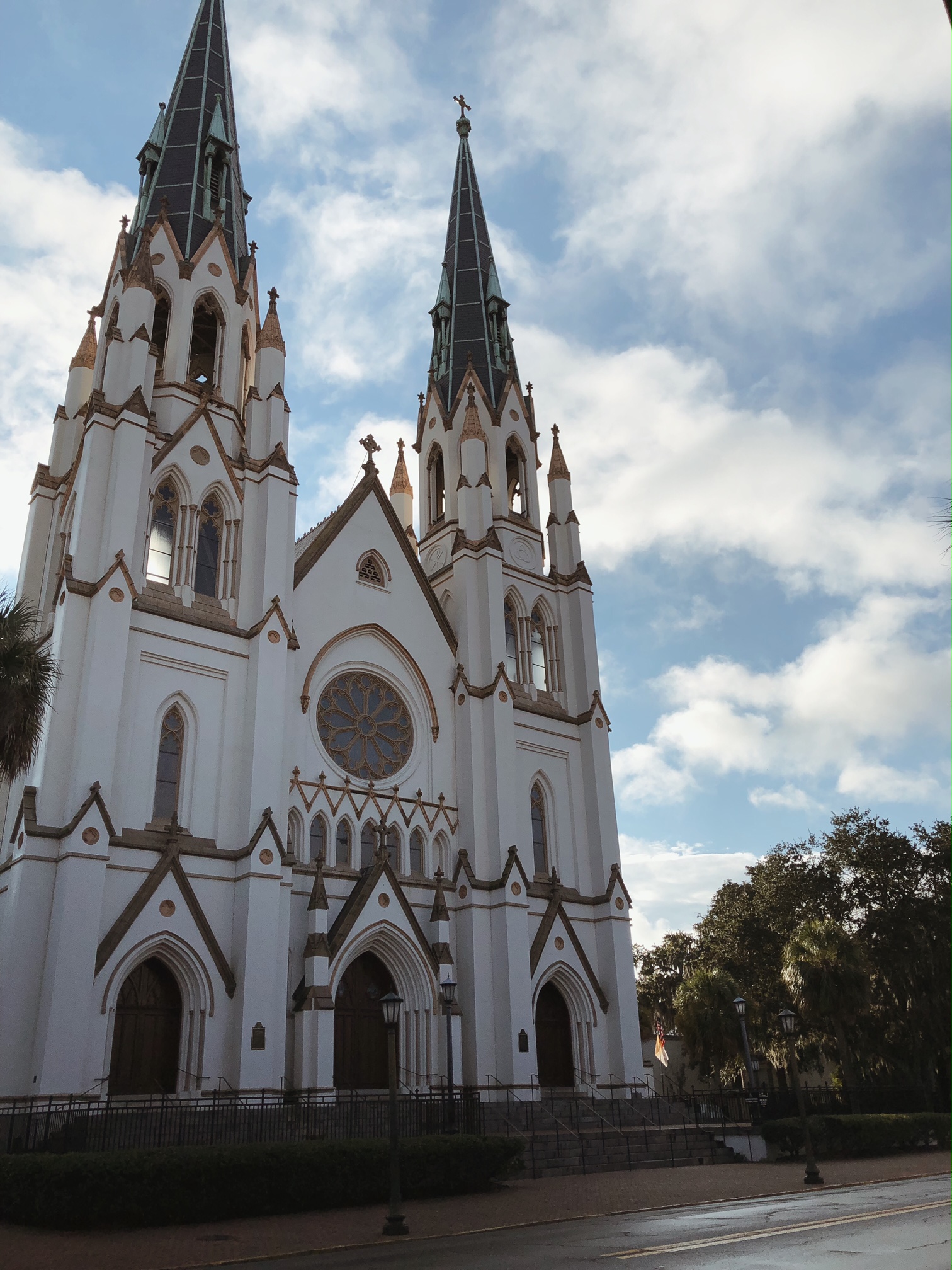
Southern Savannah Autumn / Winter


I travelled north, to the south. Can one travel in a paradox?

Southern Savannah - Strolling the sun-dappled sweet streets oozing with southern charm on the days betwixt Autumn and Winter was pure delight. The leaf-laden sidewalks lead me to all the places I needed on a short holiday - to coffee shops and bookshops. What else is necessary? Okay, restaurants/cafes as well. I will grant you that - and good food is to be found. It all felt like magic to me. Something about getting away, especially in these last two years, has felt like a pure treat. A treasure to behold. I love being home, but I also love travelling. It is the double-sided coin for me.

Though all these places are familiar to me, and have seen my presence in the last year, I still felt a keen sense of wonder, as if seeing it all for the first time. Mum of course, hadn't been to Savannah to explore in many many years. We could not really remember when it was, and these places we went were not on the agenda back then. We had a most luxuriously leisurely Thanksgiving dinner at the hotel restaurant, the 1540 Room, which we would recommend. Delicious food prepared by the new chef there. I got to eat at my favourite vegan restaurant, The Fox & Fig, and have coffee at my favourite coffee shop, Mirabelle. Best of all, I got to do some book shopping at both E. Shaver's Booksellers and The Book Lady Bookstore. All the while, walking to each place along the Autumnal verging into Winter (and Christmas decorations!) squares and historic streets.

The mornings were cold, around 37 - 40 degrees. And I was all giddy to have a taste of Winter (to me) whilst gazing admirably at the multi-hued leaves hanging loftily from many trees, with some piles of leafy colour on the ground. It was a lovely mixture of Autumn and Winter holding hands in the same days. I love the display of seasons. I love the way nature shines with all the beauty it is given, as God created it all with flourish of imagination. It is just being itself, and it is glorious. And a wonder-filled way to begin the holiday season, with the start of Advent.

02 December 2021

Autumn Bordering Winter


Autumn Bordering Winter

Oh let them fall
All the leaves all
Falling, papery thin
Hues of myriad I saw
Whilst in a state of awe
I watch them fall
With a half-floating tilt
They tip their tiny hats
As they gracefully glide
For a wistful moment, slide,
Slice, and saw, through air.
A nature show for all
That display of beauty in colour
Short-lived and transient
Soothing a salty temperament
As reminders of a seasonal glow
Worth lingering moments to know
Such secrets of nature, a clear call
To gather every one and all
To a conference of the leaves
Before bordering winter as it may please
Comes swiftly like a wind
Can we see it all again? 
Once the dancing leaves fall
They do not look back at all.

Special thanks to the leaves of Savannah, Georgia this last week for their display of beauty and colour. To allow my feet to shuffle amidst them and see their late season glory. It was a gift to my Autumn loving, chilly weather needing soul.