03 July 2024

The Light of the World


A visit to Keble College Chapel, Oxford
To see "The Light of the World" by Holman Hunt (1827-1910)
Marvelous pre-Raphaelite painting.

Behold, I stand at the door, and knock; if any man hear my voice, and open the door, I will come to him, and will sup with him, and he with me.
- Revelation 3.20

Tucked into a small side chapel in the grand Keble College Chapel is the great painting by Holman Hunt, "The Light of the World". Hunt painted two of these, the other original is in St. Paul's Cathedral in London. I have been blessed to be able to see both of the original paintings in person. On this recent trip to Oxford, I wanted to take a little time to visit the one in Keble College.

It was a windy, chilly day in Oxford. We had lunch on Broad Street at a new favourite spot, Theo's Cafe. Then, we took the little walk beyond the Weston Library and by Wadham College and Trinity College. Keble College comes next, which stands across the street from the beautiful Natural History Museum. Keble College stands out amongst colleges as it is both newer and also built in brick, so it has a very different tone. Grand and spacious it is though, and worth a visit. Worth a visit alone for the chapel. 

Entering the chapel by the huge wooded doors the immediate hush greeted us with a calmness and quiet from the gusty winds outside. A few other people were shuffling about the chapel as well. My feet took me straight up the center aisle feeling the immensity of the space, up the steps toward the altar, and to the right through the small door into the side chapel. To spend a little time with "The Light of the World.

The painting absolutely glows. I love the play with light and the dusky early evening light. The lantern light reflects off several other places in the painting showcasing the overgrown vine on the door, allowing the viewer to see that there is no doorknob on the outside of the door. One must open up to Christ - He will not force open the door. But He is always pursuing. He knocks. We have the freedom and choice to open to Him, or not. 

Christ holds a light, but He is also the Light of the world. He tells us to be lights of the world, as recorded in the Gospel of Matthew (Ch 5.14-16), which has always been my favourite verse:

“You are the light of the world. A city that is set on a hill cannot be hidden. Nor do they light a lamp and put it under a basket, but on a lampstand, and it gives light to all who are in the house. Let your light so shine before men, that they may see your good works and glorify your Father in heaven."

I stayed in the chapel for a little bit. No one else was in there so I took my time. I could have stayed easily for an hour, just sitting there looking at the painting under different angles and light. To sit with my journal and write, and pray. It is a place that holds a quiet meditative closeness to God. A place I will go back to with a very glad heart.

19 June 2024

Landscape of the Mind


"If I know nothing of my own garret," I thought, "what is there to secure me against my own brain? Can I tell what it is even now generating? - what thought it may present me the next moment, the next month, or a year away? What is at the heart of my brain? What is behind my think? Am I there at all? - Who, what am I?"

- Lilith by George MacDonald

You are in your mind all day. It is an extraordinary thing we have as humans, to be in thought, consideration, musing, pensiveness. Truly amazing, it is, as we can revisit memories and times from the past, all from our perspective. We can dream and sometimes remember dreams that might be realistic or outlandish. This is all both a gift and a challenge that we have such power in our minds. Because we have the choice of what we do with it all. While revisiting memories can be a joy, from some wonderful encounter, trip, conversation, or event, it can also allow us to choose to hold onto something that leaves us bitter, that stirs irrationality, or that causes us to resist ideas of reality. 

As humans we aren't very good at letting go and we tend to get comfortable in a mindset and don't want to step out into reality. We like the control of it, even if we know it's likely not the best for us to hold onto. We are too comfortable in our own way, and think it is not really anyone else's business anyway. We are each the ruler of our own thoughts and can do whatever we want to. A fierce independence separated from an objective moral value is the way of the world today, as C.S. Lewis wrote about. He points out that the moral environment is not something we invented, it is something we discovered. We hear often today that everyone can make their own values and do whatever they like, rather than subscribe to some "rules" that seem restrictive, and yet those who are living with that idea are actually abiding by the ideas that values are objective in order to stake their claims. If you truly step outside the objective values then you are running your life by irrationality and emotion of the moment. 

I have written several posts about my love for Lilith by George MacDonald. I am just diving into another re-read, because this book is beloved. It's fantasy, and so odd and strange in the best ways that leave me thinking and musing its questions and paradoxes. It begins with a young man, who has the views of a scientific materialistic mind, who has come back to his family home to live, and it's ancient and full of hidden passages. He sits in the library reading most days, until he starts seeing things. An elderly librarian of old days who appears then disappears. Rumors of the house being haunted leaves him skeptical, until he sees the old man again, and follows him through many twisting passages and staircases to an unknown quarter. He views a mirror into a landscape that looks into another world, and stumbles into it, landing in the other realm, met by this older man, who sometimes looks like a raven and sometimes an old man. The narrator doesn't believe he has come through a door, as he never saw a door (remember, he's a materialist and only believes what he sees), and Mr. Raven begins to befuddle his brain - 

"I never saw any door!" I persisted.
"Of course not!" he returned, "all the doors you had yet seen - and you haven't seen many - were doors in; here you came upon a door out! The strange thing to you," he went on thoughtfully, "will be, that the more doors you go out of, the farther you get in!"
"Oblige me by telling me where I am."
"That is impossible. You know nothing about whereness. The only way to come to know where you are is to begin to make yourself at home."

If this sounds a little bit like a mix of C.S. Lewis's The Last Battle ("I have come home at last! This is my real country! I belong here. This is the land I have been looking for all my life, though I never knew it till now...Come further up, come further in!") and The Adventures of Alice in Wonderland, I would agree. C.S. Lewis was hugely influenced by MacDonald, seeing him as his mentor (like Dante viewing Virgil as his mentor). Lewis Carroll was good friends with George MacDonald and spent a lot of time with the family. The writers and books speak to one another in real time and across time, it's wonderful. 

It invokes the wonder and mystery of the world beyond. Shown in ways that stretch our imaginations. So here we go on this journey of the landscapes of the mind, with George MacDonald and C.S. Lewis. Through the imagination of a story published in 1895, re-visiting with Lilith always opens me to the deeper landscapes, into places that offer seeing truth and wisdom, through doors leading further up and further in.

I reach for a landscape in my mind.
It is full of beauty and calm, a place
Familiar like memory from the deep,
But telling that it's only the surface.
There is so much more, we think
We know all the detail we see
It passes by us each day ensured
By our preeminence we feel free
While held fast in the grasp, held.
The hardest thing is to loosen the fingers
Strangely secure to grasp the control
Though preventing true freedom in divine 
Whence in release allows air to extol. 

05 June 2024

Sundry Reading Days


As laughter here breeds laughter, there above sheer happiness shoots brilliant flares. Below, a darkening shadow marks the saddened mind.
Paradiso, Canto 9, Dante

Readers read together and alone. The beauty of reading is that it can be solo, or you can read with others either at the same time, aloud, or silently. If you are like me attached to the physical book (the wonderful feeling, smell, texture, essence of the book itself), batteries will not run out, no books will run out of charge. No books will kick you out when your subscription time has elapsed. In fact, books invite you in - to deeper understanding, learning, and perspective. Inviting you to linger on the pages. 

Reader, are you constantly looking for more time to read? Etching out our schedule so that you squeeze a few hours (or more) into weekends to read? Cast aside other plans to read? Decide not to go out because you'd rather read? Ask everyone you know what they are reading? Ponder to yourself how anyone could think there was such a thing as too much reading? 

If you are wondering why someone would want to read so much, it's a fact of sundry reading that you get a wide variety of books to enjoy and learn from. Last weekend I finished reading Plato's Phaedrus, his take on friendship, and then finished reading The Divine Comedy by Dante in a modern translation I had not read before and loved it. Then I summed up last week by reading The Early Church by Henry Chadwick, which starts from the beginning of the church in the ancient world and into the first few centuries AD. Then, just for fun I threw in Die with Zero by Bill Perkins, a book about living experiences now to build up memory dividends and not waiting for some future date, and also My Salinger Year by Joanna Rakoff, a memoir of a young women in NYC entering into the literary agent world in the 1990s. 

In this delicious stew of books, we have philosophy, fiction/poetry, history, business/finance, and non-fiction. From ancient BC writings, to the current modern day ideas. I would argue that you cannot get this robust flavor or serendipitous compilation of ideas and thought-provoking encounters except by exploring the world of books and allowing such meetings to occur, mix, and provide a plethora of musings.

Perhaps you think me too fastidious to place such importance onto books and these chance encounters. But I would come back and say that books talk to one another across time, space, and my tiny apartment. C.S. Lewis is always referencing ancient writers and I go to my shelf to grab that book to read. Dante seeks wisdom as his mentor Virgil comes out of the ancient world to guide him. Books reference one another, play off one another, build off older ideas, describe ideas in context of today. The more I read, the more I learn about to read more from the references. Who were your authors reading? How did they formulate their ideas?  It's a cycle of research I am very glad to get on and around every corner there is a whole new shelf of authors to discover.

23 May 2024

Values from C.S. Lewis


It's been too long since I read a C.S. Lewis book. But this is one I have been wanting to re-read for a long time, and to read with the companion book by Michael Ward, After Humanity. Why is is titled After Humanity? If you are familiar with the message of The Abolition of Man, you know it is C.S. Lewis's warning to humanity from his perch in 1943 (he gave three speeches at Durham University that became this book) on the affects of subjectivism and the future of humanity. Living the post-modern, post-truth culture that we are in today, this warning from the past is all too familiar in what is pervading all areas of our lives. It is not a cheerful message, and he hitting very close to home in today's world. 

Needless to say, likely because of its relevance and because I have read it a couple times before, I flew through the book again along with the wonderfully commentated companion book by Dr. Ward. Lewis's book is very slim yet dense and thought provoking. Of course, being familiar with the book already I knew what the arguments were and where Lewis goes with it all. But the deeper analysis of what he was saying, or what he was referring to, thanks to the companion book, I am able to better perceive the arguments he lays forth in his masterful ways, keeping in mind in such a slim volume he does not cover all angles and has some missing pieces such as addressing arguments that could be made against his own.

Are things beautiful, good, and true just for us as individuals, or can we speak and feel about them in ways that are us beyond our isolated perspectives into a shared discourse of objective value? (After Humanity, pg 14)

Lewis jumps right into the issue from the start, using a concrete example of school textbook which teaches on controlling language, and at the same time displays lessons on subjectivism (eliminating a sense of shared morality). Lewis then discusses the danger of entering these radical yet subtle ideals the authors of the textbook seek to do in controlling language. The sense of accepted moral objective Lewis calls the Tao (he uses this term as a means to be applicable to anyone in any culture, not based on religion, this sense of similar moral values that all would agree on and obey through life, no matter their religion). How straying from this set of moral values can lead to a very dangerous end.

Ward explains, "the universally accessible Tao, and all therefore agree in principal on the objectivity of moral value. The Tao is not something that human beings simply make-up; it is something they discover." When someone steps outside this moral value standard, they step into a void. They lose all sense of framework for practical reason and decent moral choices. They are free to act of course, against the standard morals, they can abandon objective value, they can choose to bring about their own abolition. This is the message of the book. 

Lewis writes, "You say we shall have no values at all if we step outside the Tao. Very well: we shall probably find that we can get on quite comfortably without them. Let us regard all idea of what we ought to do simply as an interesting psychological survival: let us step right out of all that and start doing what we like. Let us decide for ourselves what man is to be and make him into that: not on any ground of imagined value, but because we want him to be such. Having mastered our environment, let us know master ourselves and choose our own destiny."

Lewis stood from a place in history during WWII where totalitarian dictatorships and controls of government were very serious matters that were reality. He warns against having moral blindness, for to see through all things is the same as not to see.

If you are looking for a way to engage with today's issues from a perspective outside of today's culture, seek out C.S. Lewis. You will be wiser for it, and better equipped to face what we are seeing today.

16 May 2024

Long Journey with Aquinas


I have been on this long 800+ page journey with St. Thomas Aquinas and his writings, which mingle philosophy and theology from his perch in history (1225 - 1274). It has been a fruitful and intellectual journey, one that has deepened my understanding and challenged me because I am no theologian and I barely know philosophy (my reading stack is always growing with philosophy books).  I had never read anything of Aquinas and when I learned that he drew from Aristotle and saw the importance of philosophy as a necessary tool for a deeper understanding of faith, I knew I had to get introduced to him. Now that we have been introduced, and I have completed this book of his selected writings, I thought I'd share a brief summary, though by no means do I feel well versed as I have only scratched the surface, and this summary will be woefully incomplete. 

As with any long journey, you want to have plenty of liquids to keep you going, so Thomas became my coffee companion in the mornings. I like to read philosophy in the morning, preferably when my mind is most awake and sharp (coffee surely helps with that). Accompanied by a cup of coffee I would read a few pages from Thomas Aquinas, exploring his ideas, which often had their origins in Aristotle, but not to copy or conform to his ideas, but as a spring board into deeper understanding of the Christian faith, showing how God reveals himself to us through images and likenesses. A reminder that there is truth to be gleaned in the ancient philosophers, though not all is true. 

Reading a few pages at a time was ideal, for Thomas is a deep intellectual and much above my head. He would often pose a question and then proceed to answer both sides of the argument. It is amazing to read as it guides you through the process of a debate. It strengthens his argument by already laying out the counter-argument before he proceeds. This aspect of his argument style writing is already stretching me in how to build a better argument. Instead of asking what I think or know is correct, asking what would the opposite reply be as well. It does draw out the reason of an argument if you lay out a reply and a contrary reply. Then you conclude with the response. That's what Thomas does, and I am learning from it.

He poses the questions and responds on all ponderings of life - About happiness, truth, goodness, evil, science, conscience, God's existence, divine nature, the soul, words, the ultimate end.  

...happiness is a good exceeding created nature. Hence is it impossible that it came about the action of any creature, but a man becomes happy solely through the agency of God, if we are talking of perfect happiness. 

I read these arguments about happiness and how it is so counter from our culture and its total embrace of "do whatever makes you happy", which is never going to fulfill because doing what makes you happy, i.e. selfish desires, will leave you empty as it excludes God, and fleeting desires will satisfy for a short moment, at best, but will always leave an emptiness because it's not letting that good thing lead them to something deeper, that is, God. Some enjoyment or pleasure is not true happiness, and if it doesn't lead one to reach deeper to desire the true end of that desire (the ultimate good of God), one will be left wanting and empty. Even going back to Medieval time in history these issues were around in culture. It isn't anything new, and yet how we have not learned from this, and grown even more robustly ignorant of this truth. Hence the consistently rising mental health issues,  broken families and relationships, and people walking away from church in general. 

It's difficult to quickly list or quote from Thomas because he builds these arguments in steps and cherry picking is not ideal. It's best to read the whole of a question at least, to get both sides of the argument and his conclusive reasoning. I am just dipping into Thomas and his writings (800 pages is a dip). To gain a better understanding and meditate on such ideas, which he draws from those such as Aristotle, Augustine, Boethius. It leads me to want to re-read those authors, who I am already friends with, but would like to hear more of their thoughts. One author leads to another - it's one of those great joys of reading.
What are you reading that has been challenging you lately?

08 May 2024

A Peak into the Bodleian Libraries


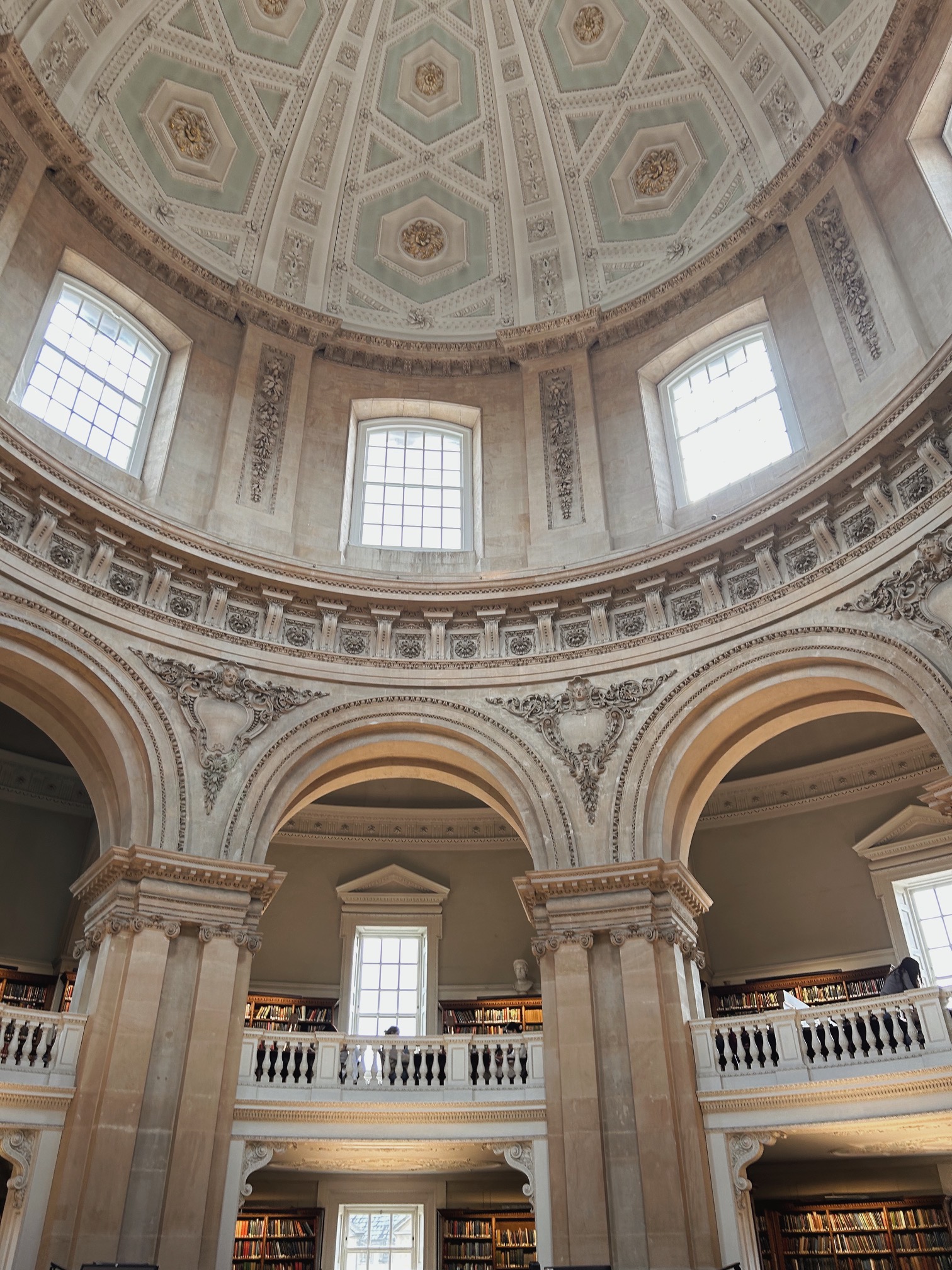
Any instance I get to step foot into the Bodleian Library (any building of the many buildings), I feel like it's a special occasion. I have not taken a tour of the Bodleian in many years, probably 6-7 years ago, and I have been really wanting to go back in to breathe in the air of the libraries, to be close to those oldest books of the Duke Humphrey's Library, and enter the Radcliffe Camera again with the most gorgeous dome and classical round architecture amidst reading space and shelves of books. These dreamy locations are really the thing of dreams, my dream anyway.
  
I was not able to get tickets online before the trip, so I had given up hope that we would be able to visit this year. But as providence would had it, we got chatting with a lovely, friendly tour guide and information desk employee of the Bodleian, and learned we might be able to get tickets the day of if we arrived at opening time to collect the few remaining tickets they would make available. So of course we showed up to queue at opening time to get tickets for later that day. Thank you to our new friend at the Bodleian! 

The tour begins in the Divinity School, a gorgeous large room where originally lectures would have been held. It is now used for private events (even weddings), lectures, and preparation on graduation days (getting robed and moving outside to enter the Sheldonian Theatre which is just outside the Christopher Wren door). We moved into the Convocation Room beyond the Divinity School which was used for England's parliament in the 1600s during the reformation.

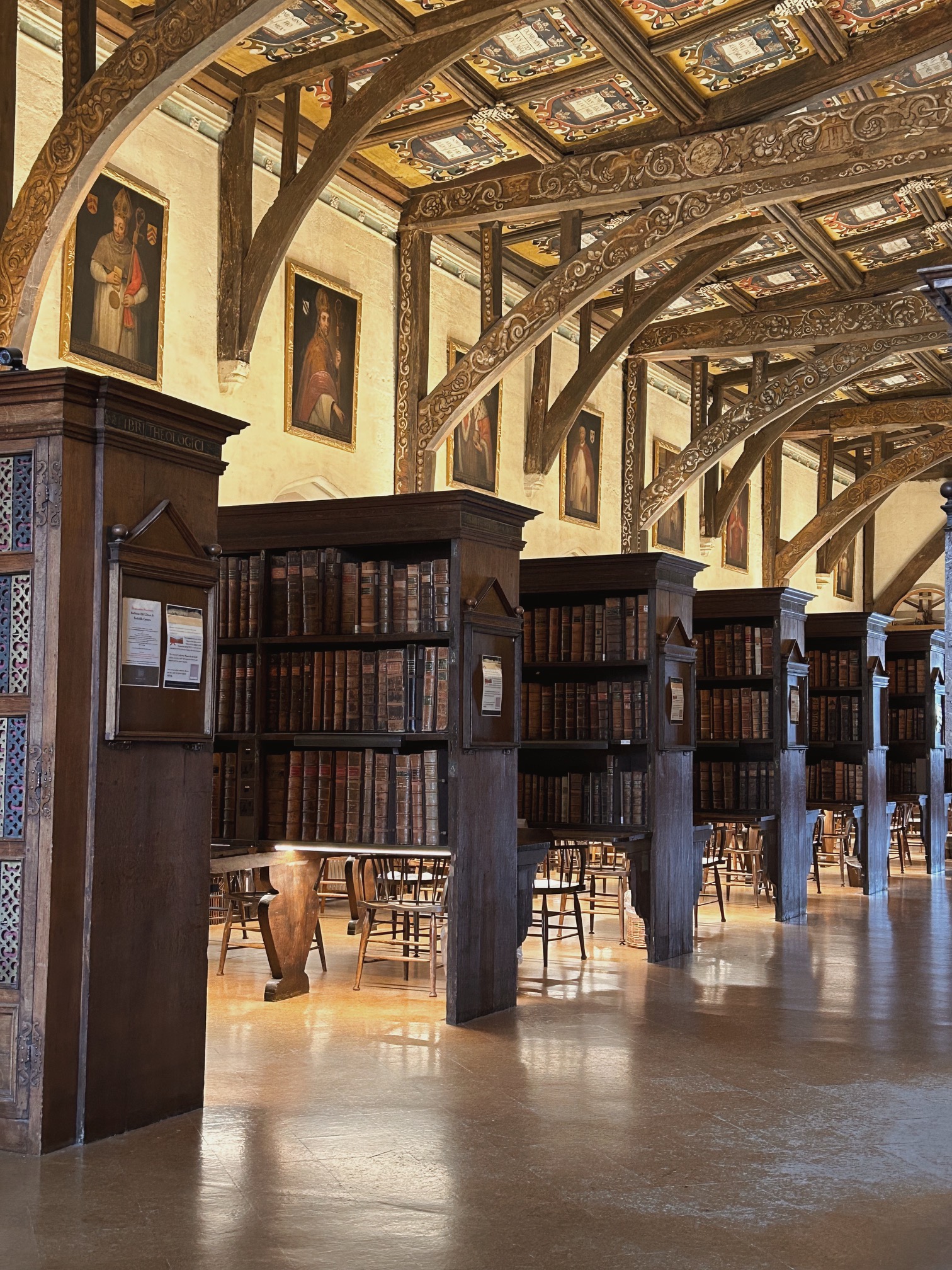
Then comes the library fun. We pass through the reader gates and climb the stairs up above the Divinity School to the Duke Humphrey's Library, which sits above it. This is the old library, where the books used to be chained to the shelves (thankfully that was removed). It features gallery style double decker layers of shelves, lower and upper reached by a tiny spiral staircase. The one section we were hanging out in housed about 14,000 books. Above our heads the ornately carved and painted square ceiling sections spotlighted many instances of the open book emblem, the coat of arms of the University of Oxford - Dominus Illuminatio Mea. It is taken from the beginning of Psalm 27, and it means "the Lord is my light". 

You might recognize this from several scenes in the Harry Potter films. Honestly though, that's a tiny aspect for me of the excitement. That's what gets the tourist booking tours, but for me, it's all about the books and the history. Bookish history and ancient libraries is completely fascinating to me - I read books about it, watch videos on it, and crave visiting such places as this, which holds such special treasures and history worth preserving. 

After going back downstairs and outside into the old quadrangle and through the walkway leading out to Radcliffe Square, we entered the gates into the inside sidewalk/lawn leading to the Radcliffe Camera. Upon entering the main door, there's a gorgeous floating spiral staircase that hugs the outside walls with wood. Each step closer to the lovely painted ceiling. The awe upon entering the large openness of the lovingly known 'Rad Cam' for a book lover, library lover, Oxford lover, is deep. There was a hushed silence as students worked. Every table and chair I could see were filled, lower and upper levels. I couldn't shake the grin off my face. I could see myself sitting on the upper level with some books at my elbow, working, reading, writing. This was a place for me. My ideal. I would be happy if everyone just left me there and I'd gladly spend the rest of the day right there. 

But, alas, I had to move on. We went to a different staircase that went straight down into the Gladstone Link, an underground section of the Bodleian with huge metal moving shelves that could be crammed together, more seating, and then onward into the space age tunnel (though the whole sections underground are from the early 1900s and used to house a conveyor belt that transported books from one building to another) that connects the Rad Cam to the Old Bodleian and the Weston Library even further away another block away. I love that there is an underground tunnel system connecting the main Bodleian buildings. It's another secret of Oxford that most people don't know about, and it peaks my imagination. Definitely one of the highlights of my visit.

30 April 2024

Bookish History in Oxford


Everywhere you turn there is bookish history, buildings, bookshops. Colleges house libraries. The Bodleian Library is several locations. The history of the Oxford University Press spans from Broad Street out to their huge building up in Jericho north of town. That's where this day led us. 

Everyday begins with breakfast in the dining hall. It's a true Oxford experience. A great way to get the day started with a plate of fried eggs, tomato, baked beans, hash brown, bacon, a cup of Earl Grey, and some fruit. Like a typical day in college, people are buzzing to and fro getting set for a day with some schedule ahead. 

The journey up to Jericho had a nice long pit stop at Gail's Bakery for coffee. The essential of everyday is time in a coffee shop. I fill pages in my journal as I do every morning. It's something I do every day normally, so it's the most natural thing to me. Have you tried journaling each morning? It's a wonderful way to get thoughts out, process through thoughts and ideas, write out prayers, and sometimes come to answers and conclusions by way of exploring them. 

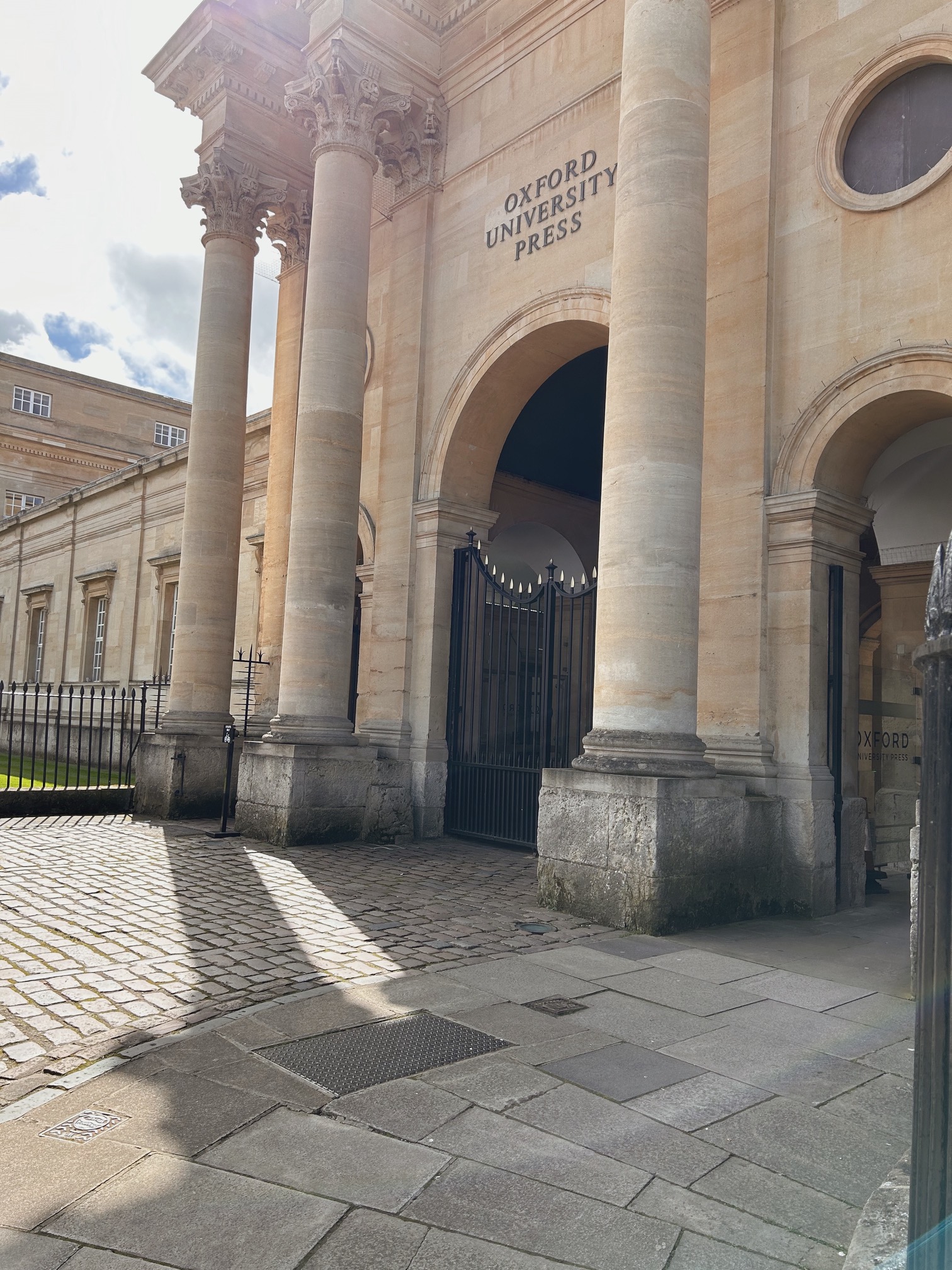
Wanders by foot are always the best. Along the way there's so much to see. Shops, buildings, post boxes, architecture, trees and blooms, all on the way to the eventual lunch at a favourite Rickety Press for a burger. Good fuel before our tour of the Oxford University Press. I had taken this tour many years ago, and it was fun to re-visit the huge site to visit the museum, library, hang out in the employee lounge area, and make friends with an employee who led us out via the usually restricted main quadrangle and the main gate - I felt so official and I love getting to see the insides of places you don't normally get to access. 

The Oxford University Press location employs about 3,000 people and has a library they can all use, a gym, coffee bar, big cafe, lounge, and very cool modernized interior spaces within these old buildings. The OUP is a department of the University of Oxford and began its printing in the 15th century. The current location has been there since 1830. Before that, it was located on Broad street first in the Sheldonian Theatre from 1669 - 1713 and then the Clarendon Building from 1713 - 1830. 

In 1675 the King James Version of the Bible is printed at Oxford for the first time. The Oxford English Dictionary began in 1884 and was completed in 1928. J.R.R. Tolkien worked for the OED and it's so fun to see his handwritten entries for the "W's" as he worked on the etymology of words in 1919.

Ask me something I love about Oxford? It's all the bookish history everywhere. With so many things to explore and discover, I am always eager to learn more and feel more inspired by it all.

22 April 2024

Oxford Sparkles in the Rain


Celebrating the rainy, cosy, warmth amidst the winds, and all things English weather.

Oxford Sparkles

If you ask me, Oxford is more beautiful in the rain
The stone buildings glisten and shine,
Bookshop and cafe windows glow with warmth,
As the umbrellas pass by, I duck inside
to scope out a spot by a window and watch.
With a sense of glee the city doesn't halt.
Students on bicycles glide by along with
jacket-donned people splashing through puddles
(better if they had wellingtons, but none do).
If you ask me, Oxford sparkles in the rain
Before, during, after. It doesn't matter.
The delight is all the same in me.
The dreaming spires reach up into the low slung clouds
Sparkling stones of ancient buildings reflect street lamp light
And the pitter patter of water droplets
Dance on your umbrella as you step across
Broad street seeking a dry atmosphere and perch.
A wet journey to a place makes a place
all the better, all the cosier.
Duck into Blackwell's and browse awhile.
The rain will stop by the time you leave.
Tuck yourself into a table at Vaults & Garden,
with a tray, cup & saucer, and pot of tea.
You're all set for moments of sheer reverie.